
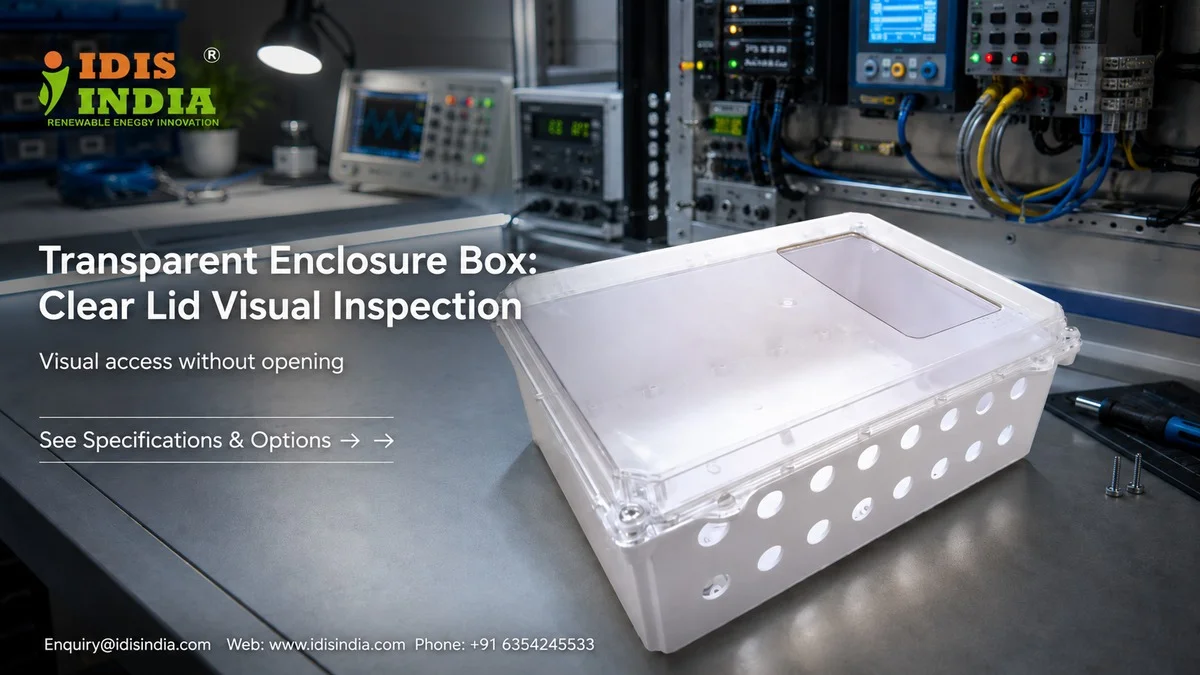
If you need to constantly monitor your electronic displays, meters, or various kinds of status indicators, it’s not practical for you to continue opening the enclosure. A see-through box enclosure with a clear top solves this problem by enabling you to visually access the contents of the enclosure without compromising the protection. IDIS India produces see-through enclosures from clear polycarbonate materials. The I-closure’s see-through boxes are designed to allow you to protect your sensitive electronic equipment while maintaining an unobstructed view of all internal electronic components. However, choosing the correct see-through enclosure requires more than just selecting a see-through box. You will require appropriate uv protection, the best viewing angle possible, and materials that will not yellow with time.
Clear Lid Material Options for Visual Access
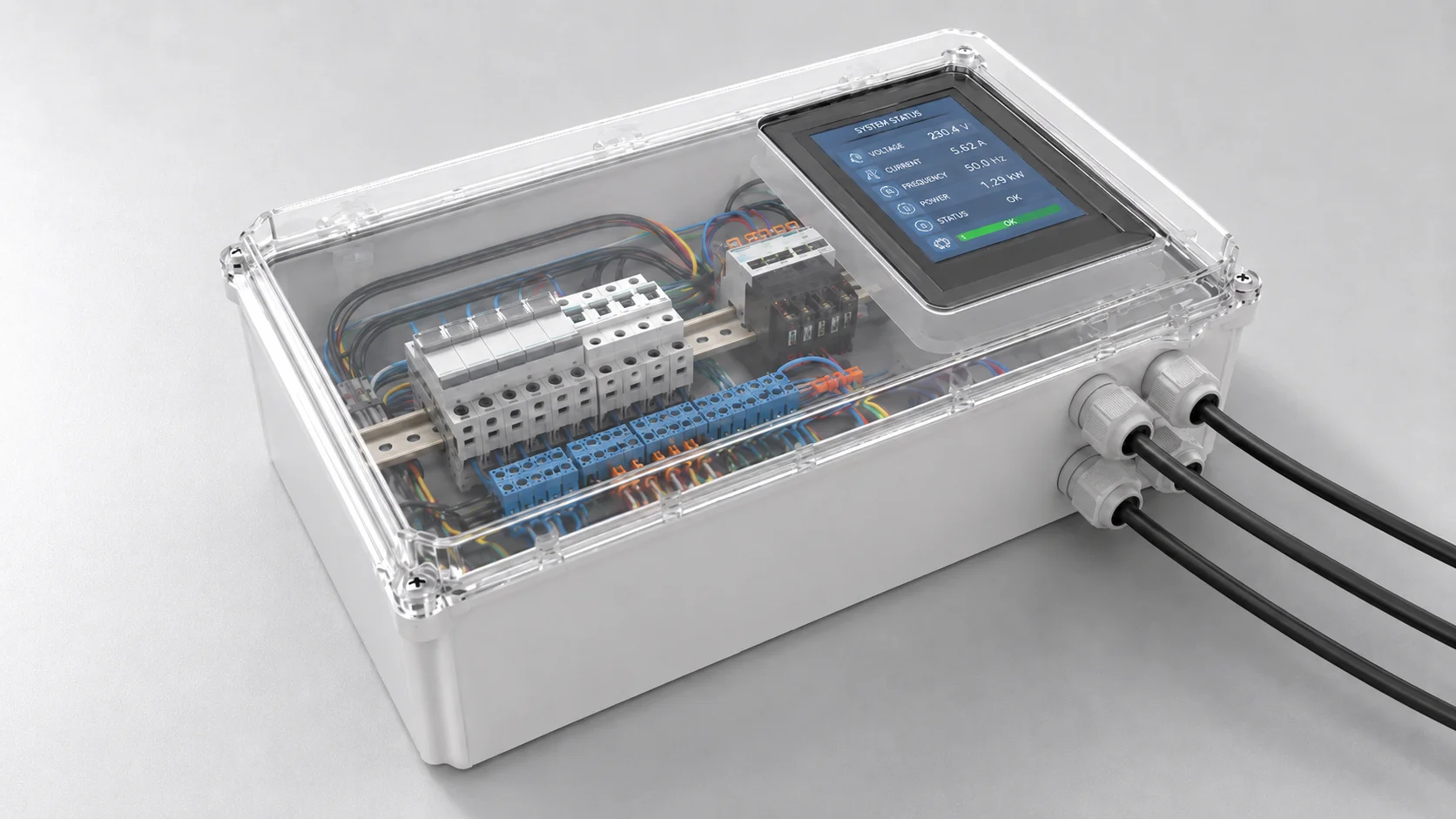
The material that’s transparent doesn’t work well for every plastic enclosure. Different transparent materials provide different advantages and disadvantages based on the application and type of project you have. Polycarbonate (PC) is the most popular type of material because of its very high level of resistance to impact and its ability to withstand temperature fluctuations better than acrylic. Additionally, polycarbonate retains its clarity longer than an acrylic will when exposed to UV rays.
While the cost of acrylic is lower at the time of the initial purchase, an acrylic becomes brittle with time. Therefore, although the initial cost of an acrylic may look good it will not perform as well over the long haul due to the increasing number of scratches on its surface from cleaning and maintenance activities. In some situations, PMMA (polymethyl methacrylate) can offer very good optical clarity, but PMMA is not a durable enough material for many industrial uses because of its inability to withstand repeated physical stresses in an indoor environment.
Consequently, our I-CLOSURES only use UV-stabilized polycarbonate as a material for their transparent enclosures. By doing so, we guarantee that the viewing window of I-CLOSURES will remain transparent for many years despite being exposed to direct sunlight.
Visual Inspection Window Sizing
Your clear window size and placement directly correlate to how well it functions. If the window is too small, you won’t have visual access to key components. If it is too big, you will risk having an insufficient amount of structure to support it. As a general guideline, most viewable windows will be sized in the range of 60% to 80% of the overall face of the enclosure in order to provide suitable visibility while ensuring that the periphery of the enclosure remains properly sealed. The remaining opaque surrounding area will be used for mounting point support and cable entries. Similarly, on fixtures that will use views for meter reading purposes, locate the transparent area of the viewing window at the same position as the display area or indicator lights. Do not place viewing windows where they might impede any internal component mounting or impede the ability of an internal component to dissipate heat. In addition, consider operator viewing angles. Will it be necessary for an operator to read the display from the front, or from multiple different locations? If there is a significant difference in the viewing angle from various operator locations, a more substantial viewing window may be required in order to maintain readability from operator locations. IDIS India is capable of customizing your window locations and sizes based upon your specific unit’s component layout. Please contact our engineering department to discuss your specific visual access needs in detail.
UV Stabilized Polycarbonate Selection
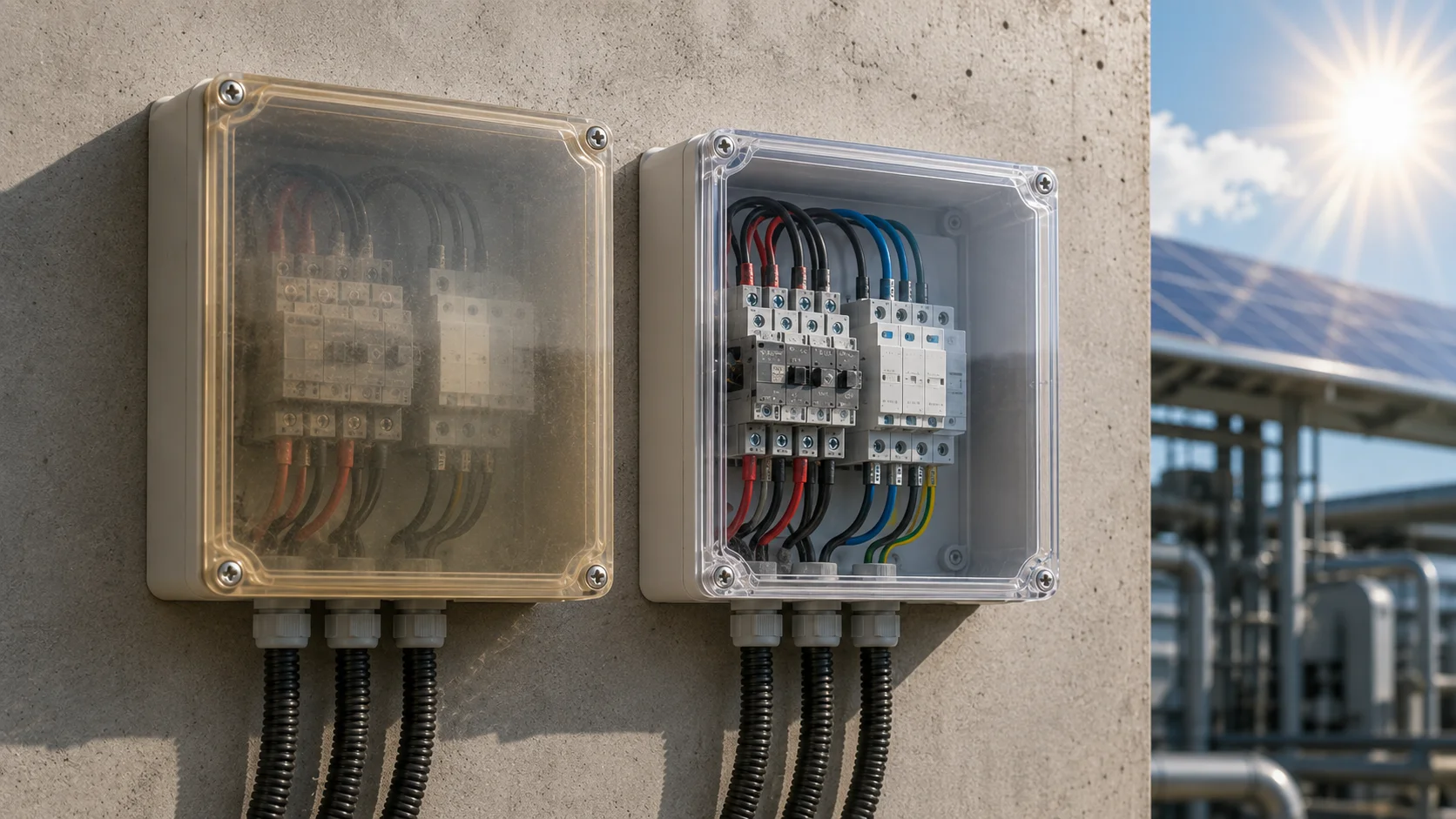
Polycarbonate that is standard will become yellow & cloudy with extended exposures to ultraviolet light. This damage goes against the whole purpose of using them as clear enclosures. Polycarbonate that has been UV stabilized is manufactured with added ingredients to absorb the UV wavelengths that would cause degradation to the polymer structure prior to reaching the polymer. The use of these UV stabilizers significantly enhances the optical quality of your material; especially in proofing applications that will be installed outdoors. Different stabilizer packages will provide varying levels of UV protection. Mild-duty formulations have been used and do well for indoor applications, where there is some exposure to sunlight. The heavy-duty formulations can be used for continuous outdoor usage in environments with extreme solar exposure. Polycarbonate will also exhibit some clarity changes due to the expansion/contraction cycle caused by temperature changes. This expansion and contraction will produce stress levels in the polycarbonate, creating stress patterns that will cloud the surface of the material. The UV stabilized grades do a good job of resisting the stress-induced clouding when compared to an unprotected polycarbonate. Our transparent I-closure Boxes are constructed from UV stabilized Polycarbonate (industrial grade). They will maintain their optical clarity for many years when used outdoors. The level of UV protection will be determined by your application requirements and the environmental conditions.
Display Readability Optimization
When using clear enclosure systems to protect sensitive electronics, viewers will experience viewing challenges, including reflection, glare, and optical distortion; therefore, employing proper design solutions will reduce these issues while increasing the readability of the display. The surface textured finish on the lens has a significant impact on the way the display appears: Mirror-like finishes create reflective surfaces that obscure the display(s) below. A slight texture on the lens provides both a reduction in reflectance and sufficient transparency for the viewer to have a clear look at the display(s). The distance from the clear lid to the display also affects the readability of the display; for example, if the display is positioned too close to the lid, parallax effects will cause the display to appear misaligned depending on the angle of viewing. In most cases, a small “air gap” between the display and the lid will improve visual accuracy. The level of ambient light inside the enclosure also must be considered; for example, the illumination of the display using LED technology will improve the visibility of the display through a clear enclosure, particularly if the ambient light level is very high. However, to a certain extent, excessive internal light will produce glare on the clear surface of the enclosure. The use of contrast enhancement techniques also helps improve the visibility of a display through a transparent enclosure; for example, with a black background and illuminated display(s), the illuminated display(s) will appear much more brilliant against the clear viewing window.
Meter Face Protection Methods
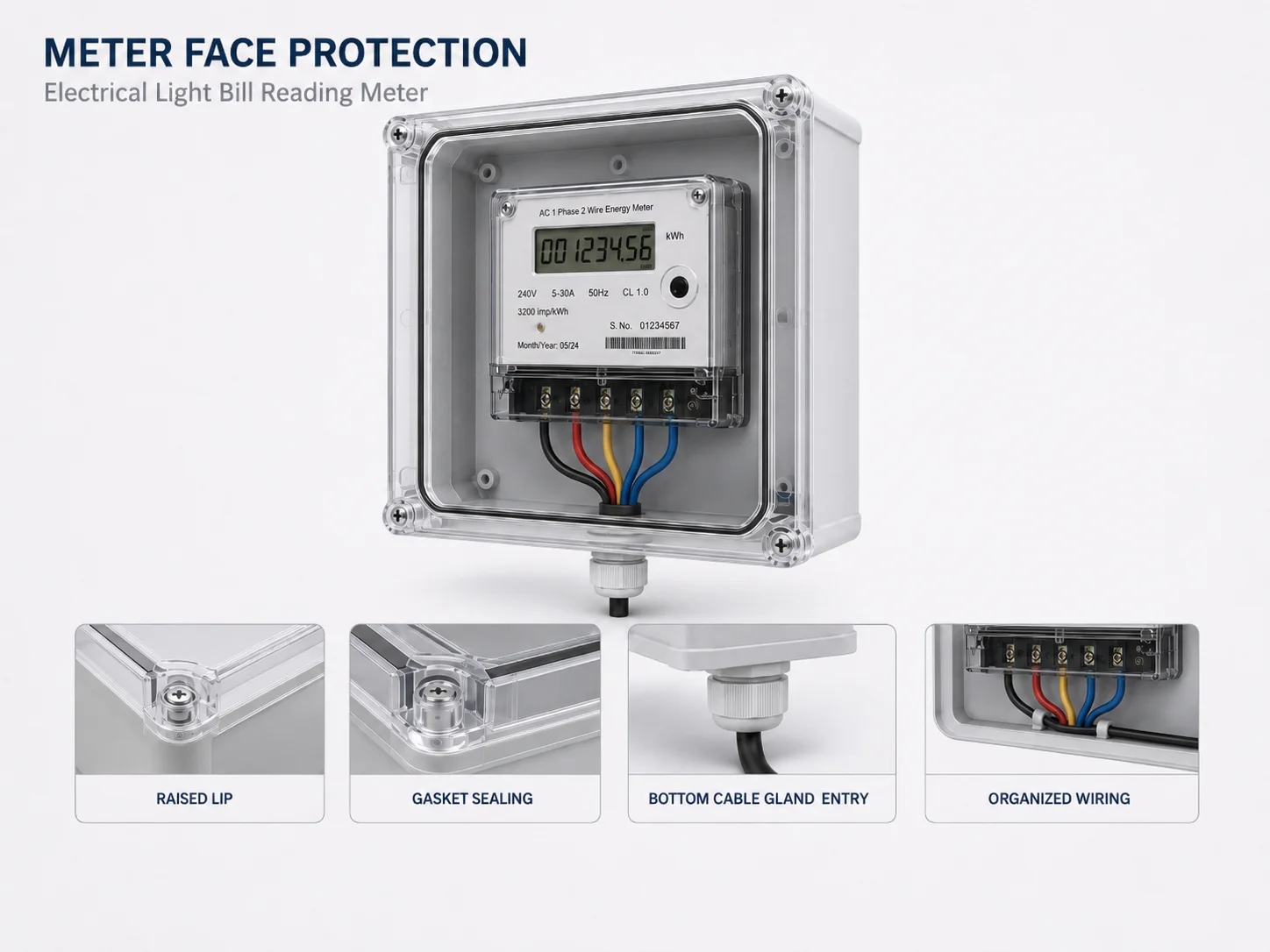
Properly designed transparent enclosures for protecting fragile meter displays include a combined approach to physical and environmental protection of an enclosure, and an optical clarity of viewing. In addition, the use of a raised lip around the perimeter of the transparent viewing area aids in reducing potential impact damage to the visible display components of the meter. The raised lip will also create a barrier to prevent direct contact between the inner meter components and the outer surface of the transparent gasket when a meter is handled or subjected to minor impacts. The use of a gasket to seal the transparent view area results in maintaining the IP65 or IP67 rating of the meter while maintaining visibility. The gasket material must maintain flexibility and will not cloud during the life of the meter. Condensation that builds up inside the meter may fog the view area and create an obstruction. Properly vented and/or placed moisture absorbents will reduce or eliminate moisture build up and prevent obscuring of meter readings. An additional concern with sensitive needle display type meters is that vibration may cause the needle to bounce, which will adversely affect the accuracy of the reading. The transparent view area should not transmit any vibrations that may occur from outside the meter, to the delicate internal components. The engineers at IDIS India provide designs of clear enclosures for protecting your specific meter type circuits with the appropriate protective features based on the specific environment requirements.
Status LED Visibility Enhancement
There are several different parts to consider when designing transparent enclosures around LED displays and status indicators. For example, just being able to see the indicator through the enclosure is not enough; in order for the indicator to be properly viewed, it has to be clearly visible under all conditions of operation. Different transparent materials allow for different LED colors to be transmitted, and to provide an example, clear polycarbonate allows for anyway, there are different colors can be transmitted well; other colors, such as blue, may be somewhat shifted as a result of the absorption characteristic of the material used. To enhance the transferring of light through the transparent material, you can use light pipes to channel the output of the LED light directly into the viewing area. This allows you to concentrate the light emitted from the indicator, making it more visible at longer ranges. Ambient light filtering is sometimes used to increase the visibility of an LED indicator; for example, tinted sections of transparent material will block the background light coming in from behind the indicator, making it appear more highly visible than if it were viewed through non-tinted material. This works especially well for red indicators used to warn; multiple LED configurations often before receiving assistance & different portions of your transparent enclosure may need to be allocated with different levels of transparency in order to optimize the visibility of various types of indicators (i.e. time & date or location) respectively; also, if indicators may be blinking or animated, any optical effects that may interfere with critical warning sequences or the communication of status protocols between the indicator and an enclosure with transparent sections must be taken into consideration when designing a transparent enclosure for use with an LED display.
Anti-Glare Coating Applications
Displays, when housed in a transparent enclosure and subject to glare from external light sources, can be unreadable. Anti-glare treatments provide the necessary anti-glare solution while also maintaining the visual access benefits of your display. Matte finished surfaces scatter reflected light and reduce glare intensity, but they do create a slight reduction in optical clarity compared to other surfaces. However, the improvement in readability under bright light conditions is typically more than enough to justify this trade-off. Another alternative solution is the use of anti-reflective coatings, which reduce the amount of light being reflected off the surface. Anti-reflective coatings maintain better optical clarity than matte finished surfaces, but they can be more expensive and require care when installing them. Also, polarizing filters eliminate specific types of glare, especially from LCDs that are viewed through a transparent enclosure; however, polarizing filter can interfere with certain types of display technologies and must be installed in the proper orientation. Surface etching creates a very small texture pattern on the surface of the display that helps to minimize glare but allows reasonable transparency. This is the best compromise between cost, durability, and optical performance. Factors that will determine which type of anti-glare treatment you use include your application requirements, your budget, and your environmental conditions. To learn more about which anti-glare treatment will work for your transparent enclosure needs, contact IDIS India. By providing the above I-closure® solution, we offer numerous differing solutions available to meet your display visibility requirements and operating environment.
Need Help Choosing the Right Enclosure? Get in Touch!