
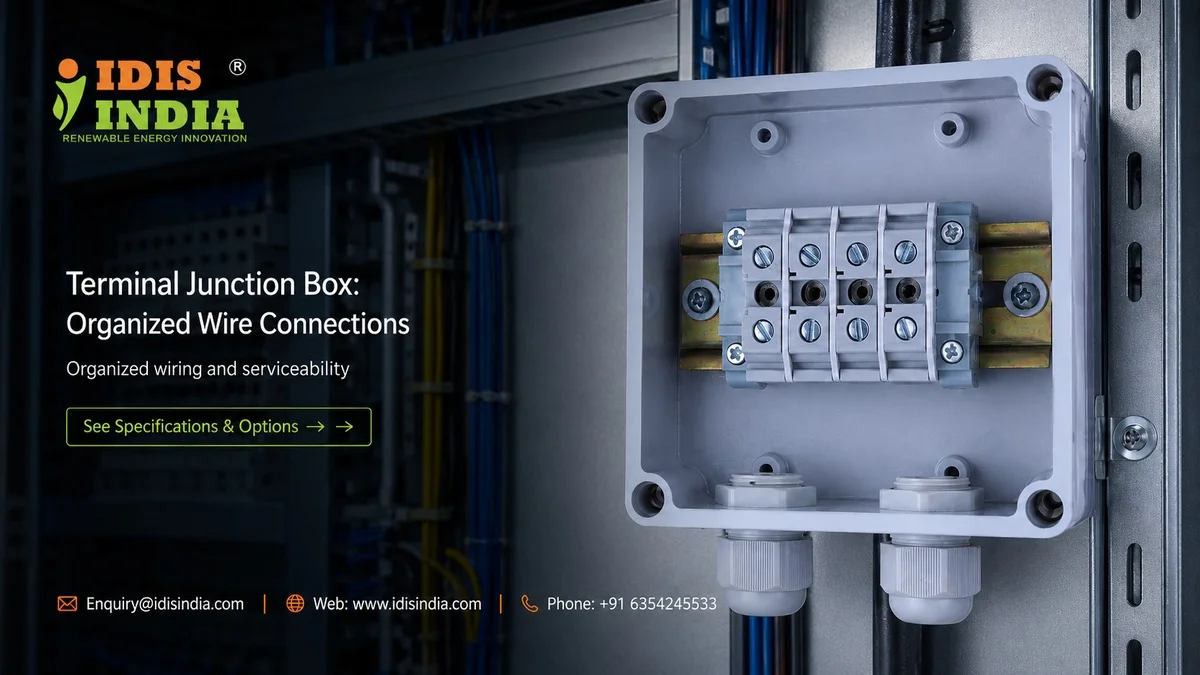
Do you require organized and clean wire connections that everyone on your team will be able to understand? A terminal junction box (designed properly) changes messy wiring into organized connections. When your electricians can track down circuits in minutes vs hours; this is value. Terminal junction boxes provided through IDIS India not only hold wires, but also help these connections to be organized. We manufacture our enclosures for the benefit of the panel builder and/or field electrician who prize clean installations.
Terminal Block Spacing Standards
Some junction boxes have a cramped feel while others provide sufficient space for installation because of the way they are spaced according to standard. The I-closure terminal junction box follows the industry standard for spacing, which is 5mm and 10mm between terminals, this isn’t done arbitrarily but rather to match up with the majority of manufacturers of terminal blocks. The most important aspect of proper spacing is to provide proper amounts of space between each of the wires to eliminate instances of wire overlap as well as reduce the amount of time required to install. Standard spacing configurations on terminal blocks includes: single level terminals with (5) five millimeters for controls and multi level terminals (10) ten millimeters for power; mixed or hybrid spaces for combination control and power applications, and custom or modified spaces for use on specialized equipment interfaces. The basic rule being that the user should select their spacing based on the gauge of the wire and how densely populated each connection will be. In the case of control wiring, tighter spacings are acceptable, however, when powering equipment there is a great deal less margin for air than with controls so greater spacings should be selected.
Wire Bundle Organization Methods
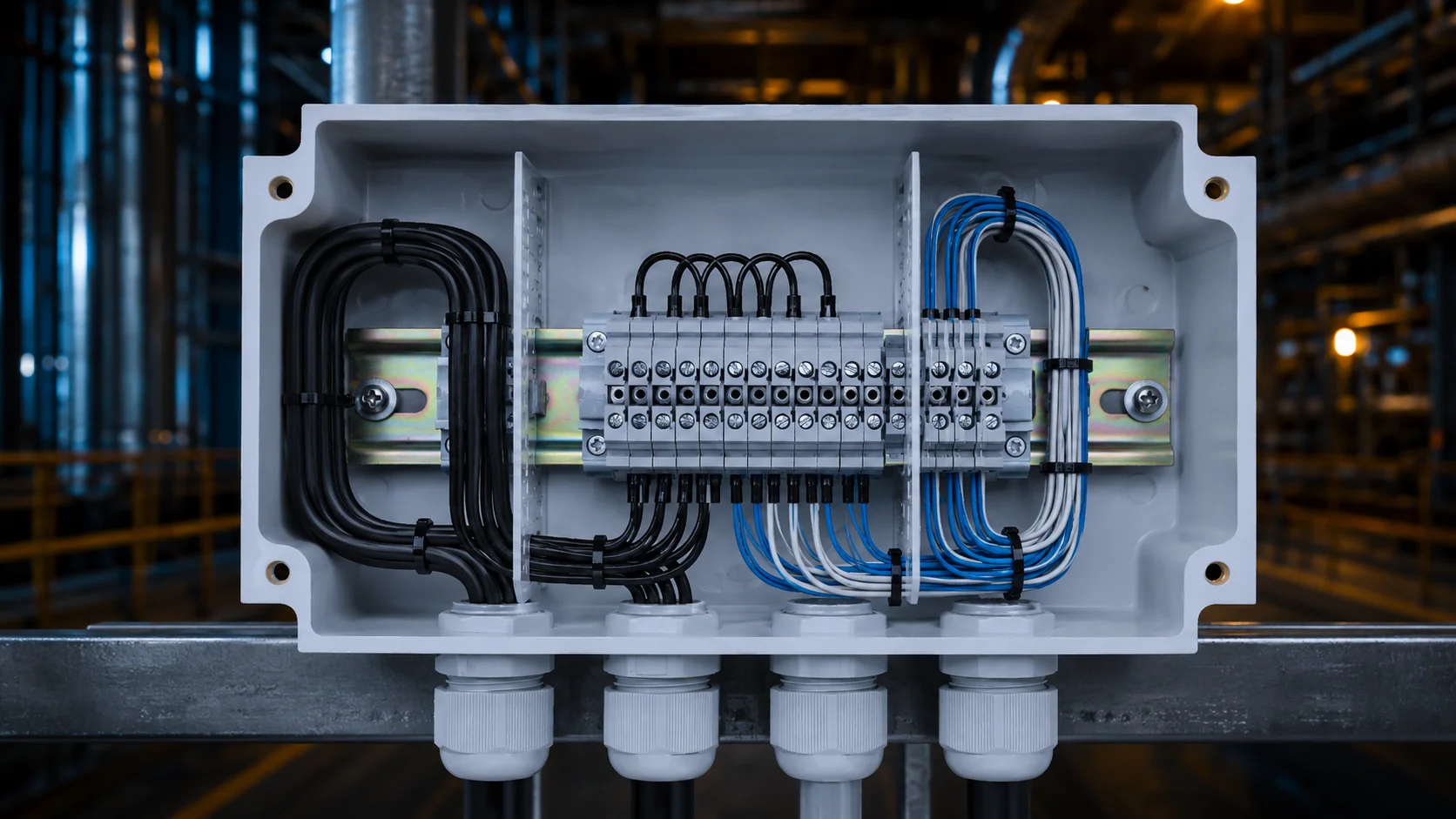
Have you ever experienced opening a junction box and having no idea where to start? This confusion typically does not have to happen if the cables within the junction box were organized properly to begin with. Proper organization of the cables begins with planning your entry points. I-closure junction boxes offer many different cable entry options but grouping related circuits together is what will make the biggest difference. For example: Power feeds are typically routed in from one end of the junction box and control wires in from the opposite end of the junction box. Here are some examples of how to organize the circuits in your junction box: Organize circuits by voltage level – keep 24V control separate from 480V power. If possible, route your input and output cables to opposite sides of the junction box. Leave your center terminal block (or blocks) for jumpers and/or common connections. Use barrier strips to create a physical separation between your different types of circuits. Don’t forget about planning for future additions; allow approximately 20% additional capacity for modifications/expansions.
Modular Terminal Integration
How can a terminal junction box be made fully adaptable? By designing them with a modular design that supports any necessary changes. All enclosures are manufactured by IDIS India with standard DIN Rail mounting which allows for use of virtually any terminal block system whether that be by means of Phoenix Contact, Weidmuller or Wago product families. The rail to rail distance provides support for both 35mm standard rails and 15mm miniature rails. Modular advantages include: Terminal block replacement without rewiring Support for mixed terminal types within a single enclosure Standardized maintenance procedures across the installations Reduced spare parts inventory But modular design is not limited to just terminal blocks. The design of our boxes allow for removable mounting plates which allow for full pre-assembly on-site prior to installation.
Serviceability Access Planning
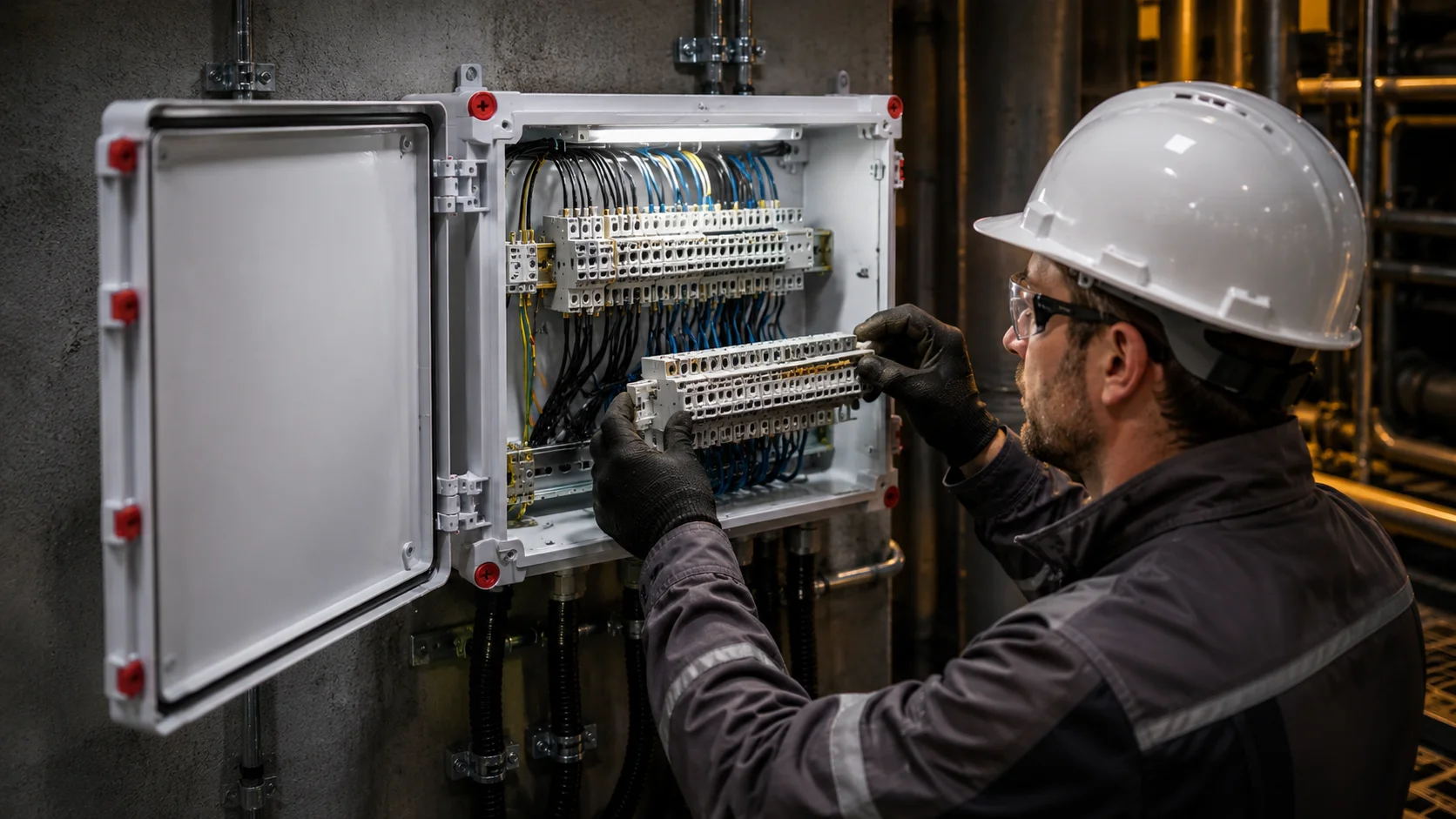
Do you find it frustrating to often need to access a terminal in the far-end corner of the building? Poor serviceability planning often causes this problem. The I-closure terminal junction boxes are designed with large opening doors and removable covers, making access easier. All connection points can easily be viewed from the interior, enabling you to work in tight spaces. Critical serviceability features include wide door openings ( up to 80% of enclosure face), removable terminal plates to allow compliance with bench-work requirements, internal lighting for work areas that do not contain natural light, test point access without needing to disconnect wires, and modular construction which allows for working on just the replacement of the terminal block without disturbing the surrounding circuits.
Field Troubleshooting Configurations
How can you distinguish between a good junction box and a great one? The answer lies in junction boxes that allow for easy troubleshooting from the field. In order to perform effective troubleshooting, circuits must be clearly identified. Our junction boxes have provisions for both permanent and temporary labeling methods. Whether you use adhesive labels, engraved nameplates or wrap-around labels, there is available space for the mounting of your labels. Some of the features of smart troubleshooting include: Test point access without the need to remove wires; LED indication mounts for circuit status; transparent covers so that you can visually inspect the circuit; and documentation pockets for storing as-built drawings. What is the most beneficial of all these attributes? Terminal blocks that can be viewed through the transparent cover will allow you to determine the identity of each circuit and to verify the integrity of the connection to each circuit without having to open the box.
Control Panel Labeling Systems
Have you ever wondered how come some control panels appear to be easier to use than others, and how often the ones that are less user-friendly require more frequent reference to drawings? The primary reason for this is due to systematic labeling of the terminal junction boxes. In fact, IDIS India offers three different label systems on their terminal junction boxes; an external labeling system to identify the function of the box or circuit group(s), an internal labeling system to identify the individual terminals, and a labeling system to designate what wires go where. When implementing an effective labeling system, you should consider the following: Use the same naming convention on every panel; Use different color codes for each level of voltage; Number the terminals consecutively with a logical grouping; Cross reference to the control drawings; and lastly, as a professional tip, label each end of every wire. This can save time when troubleshooting and when performing modifications to existing equipment.
Technical Specifications
| Material | ABS or Polycarbonate |
| IP Rating | IP65, IP67 |
| Temperature Range | -40°C to +120°C (material dependent) |
| DIN Rail | 35mm standard, 15mm miniature options |
| Wall Thickness | Typically 2-3mm depending on size |
| Door Type | Hinged or removable cover |
| Mounting | Wall mount, DIN rail, or panel mount |
| Certifications | CE, RoHS compliant |
Standard Dimensions
| External (L×W×H) | Internal Volume | Terminal Capacity |
| 200×150×100mm | Approximately 2.5L | Up to 20 terminals |
| 300×200×150mm | Approximately 7.5L | Up to 40 terminals |
| 400×300×200mm | Approximately 18L | Up to 80 terminals |
| 600×400×200mm | Approximately 36L | Up to 150 terminals |
Note: Dimensions may vary based on specific requirements. Terminal capacity depends on block size and spacing selected.
Ordering Information
Are you ready to get your wire connections sorted out? I-closure terminal junction boxes are offered in a variety of configurations. They also have a variety of mounting options to choose from. Usually, a minimum order quantity of around 50 pieces is required, but this can change based on the customization needs applied to your order.
Lead times on standard configurations are generally about 2-3 weeks, while custom configurations are typically longer. For the precise pricing, current stock level, and technical specifications for your application, please contact IDIS India directly. An engineering professional from IDIS can assist with optimizing the configuration to correctly match your project’s installation requirements.
Do you want to connect with IDIS India?Reach out today for organized wire connection solutions!
Need Help Choosing the Right Enclosure? Get in Touch!