
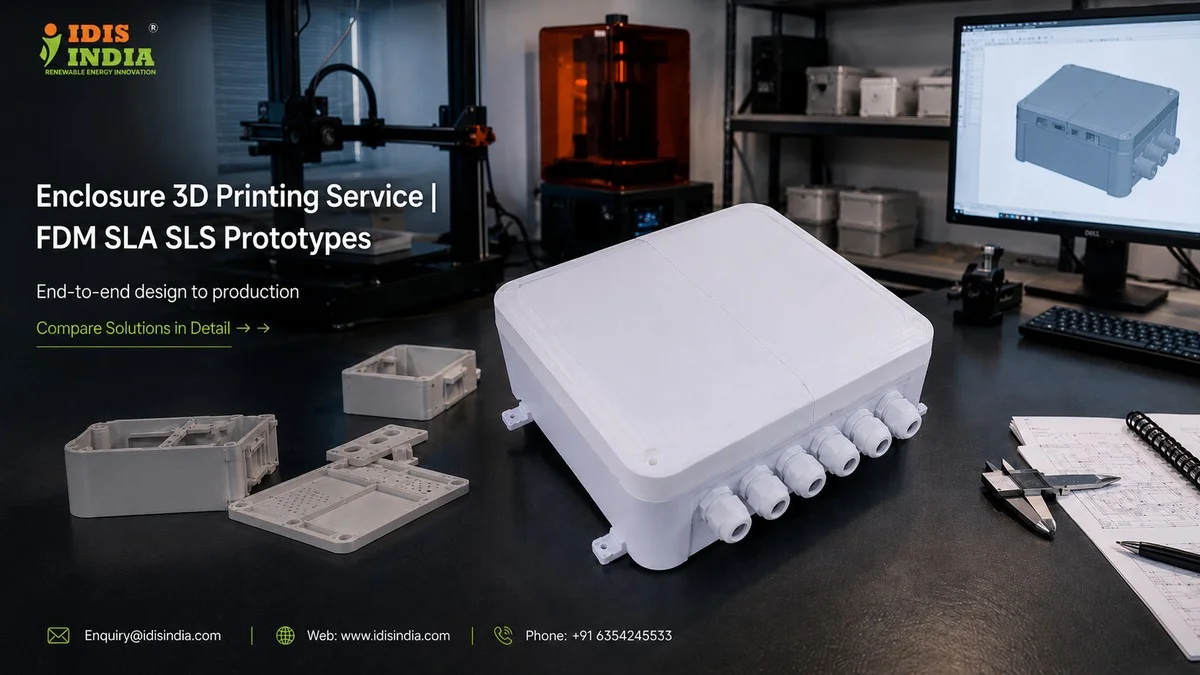
Do you require an enclosure prototype finished next week? Using traditional tooling processes, can take months to get your enclosure prototype delivered. In contrast, by using 3D printing you can receive your prototype in days. The appropriate type of 3D printing technology allows you to validate your newest design or receive low-volume production units, which leads to accelerating your introduction to market. We have witnessed many product developers and startups at IDIS India struggling with long prototype cycles. As such, we have added comprehensive 3D printing services as an alternative to standard injection moulding. Now, you can test, modify and perfect your enclosure design without spending huge sums of money initially. What type of 3D printing fits your project? When is it time to switch to conventional manufacturing? We will provide you with all the information you require about enclosure 3D printing service options.
FDM vs SLA vs SLS: Which Technology Fits Your Enclosure Project
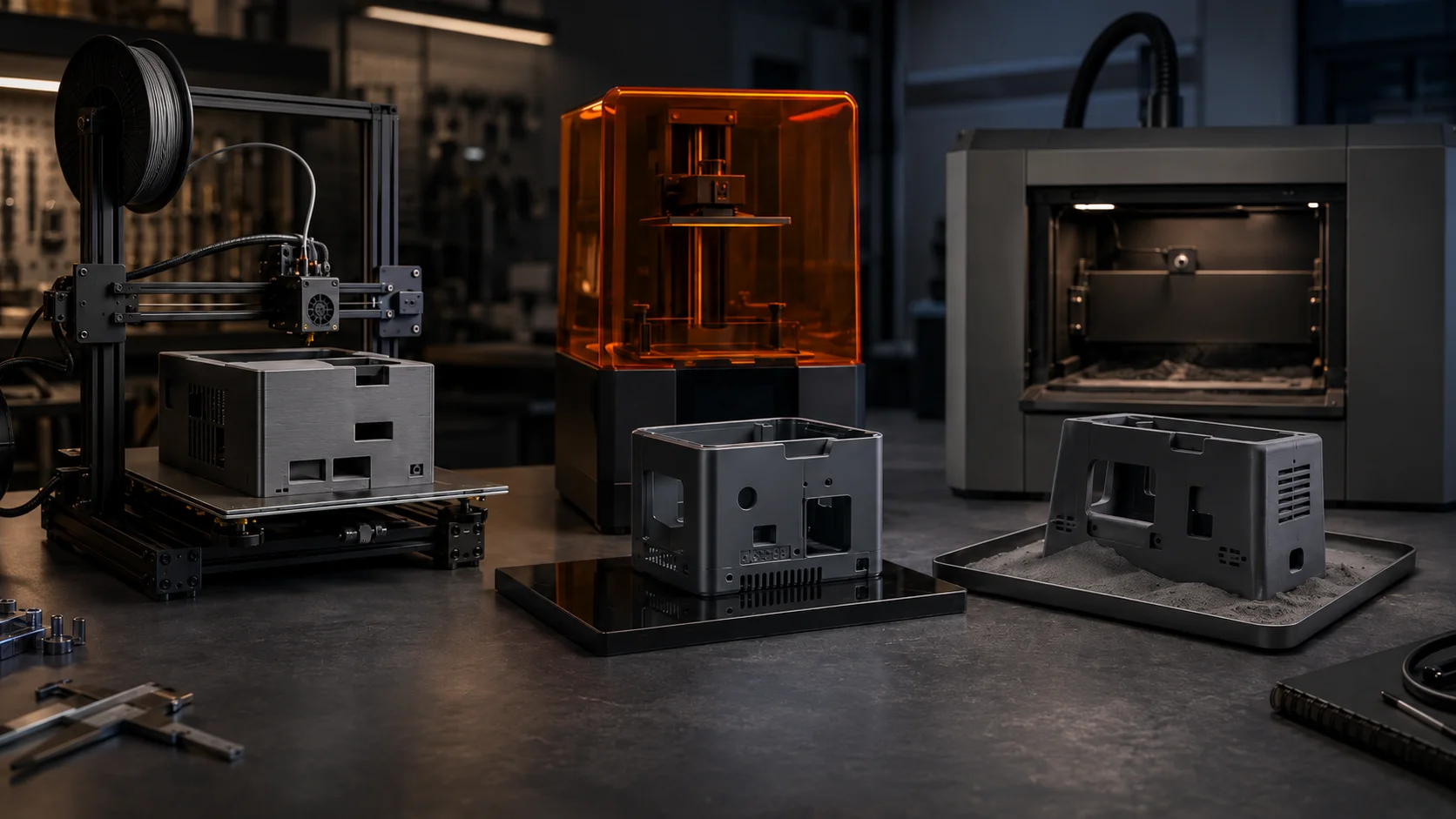
Not all three-dimensional (3D) printing technologies are made equal. This choice is going to affect so many things about your enclosures including: surface finishing, and mechanical characteristics, etc. Here is the breakdown comparing the top three;
FDM (Fused Deposition Modeling)
FDM makes components through a heatsourced thermoplastic filament being constructed layer upon layer. This prototyping method is costeffective, reliable, and perfect for functional testing.
Enclosures that are large in size, functional prototypes, and concept validation are the best for FDM style of prototyping.
Materials that fdm uses are: ABS, PC, PETG, and nylon variants.
Layer height on an FDM printer is typically 0.1-0.3mm, the maximum build volume with an FDM printer is 300mm x 300mm x 400mm, depending on the printer used.
In terms of cosmetic prototypes, FDM is not ideal since the layers are visible, however FDM is unbeatable when it comes to testing for fit & function or simple assembly due to its low cost.
SLA (Stereolithography)
With the SLA process, UV lasers cure liquid resin into solid plastic, yielding smooth finishes and fine detail comparable to injection molded parts. Most suited to making small to medium-sized enclosures or presentation models with fine detail, SLA can be produced in various materials including standard resin, tough resin and high-temperature resins. The layer height of SLA parts can be as low as 0.01 mm and have an excellent surface finish that only requires minimal post-processing to finish them off. Although SLA prints look fantastic, they tend to be more brittle than equivalent FDM prints, so if your enclosure needs to look good but not withstand much mechanical force, then this method could be a good choice for you.
SLS (Selective Laser Sintering)
Using a laser to fuse powdered materials, SLS does not require any supporting structures and produces robust pieces. Appropriate materials are nylon variations including glass filled choices. High mechanical properties. Combined with significantly increased costs relative to FDM processes, SLS produces parts suited for real-world application when the prototypes will be tested.
Material Selection for Enclosure Prototypes
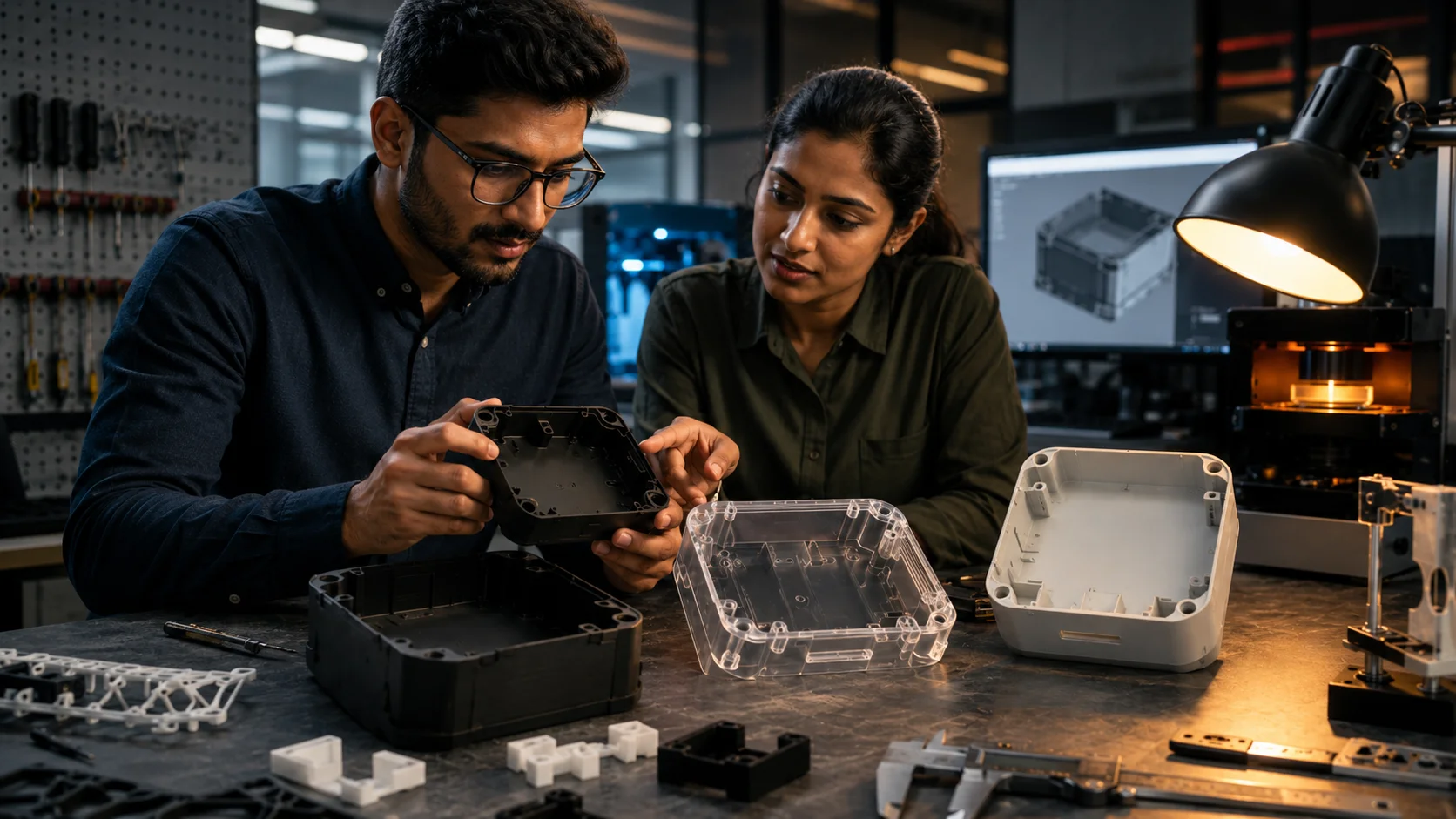
The selection of a material will impact not only the look of your prototype, but also how it performs under load, temperature and environmental influences.
ABS for General Purpose Prototyping
Most enclosure prototypes continue to be made from ABS. Due to its durable quality and low weight, as well as its machinability for post-processing, this material has become a popular choice. Temperature stability up to 80°C for continuous use; chemical, impact, and UV resistance are all moderate. Printed with FDM, ABS means you will have a very accurate representation of how the final injection molded component will perform. Many of our customers begin their project with an ABS prototype as well.
Polycarbonate for Demanding Applications
PC is the strongest material for temperature resistance (140°C), provides excellent impact resistance, has a wide range of optical clarity, and is often UL94 V-0 rated flame retardant. PC 3D prints require control of temperature during printing to achieve the same properties as commercially produced parts made from PC.
Nylon for Functional Testing
There are several types of nylon that offer exceptional chemical resistance and wear characteristics.
Components manufactured by SLS Nylon include living hinges and snap-fit features that function properly.
Chemical Resistance: Excellent
Wear Resistance: Good
Flexibility: Good – particularly in thin cross sections
Moisture Absorption: Moderate Concern
Achieving the Right Tolerances and Surface Finish
Your prototype should fit together correctly as well as have an attractive appearance. However, the tolerances allowed with 3D printing vary considerably from those of injection molding processes. In terms of FDM (fused deposition modeling) (also known as 3D printing), the dimensional accuracy of parts typically ranges from ±0.2 to ±0.5 mm. This level of accuracy is sufficient for most of the exterior features of an enclosure, but when it comes to fitting a lid tightly or accurately aligning mounting holes, you will want to be careful with this level of accuracy. SLA (stereolithography) will produce parts with much more accurate tolerances, often ±0.1 mm or better, and allow for a very smooth surface finish, thus requiring little to no additional sanding or polishing on presentation models. SLS (selective laser sintering), with respect to accuracy, falls between that of FDM and SLA but will have consistent properties throughout the part and have no areas of weakness due to layer adhesion failure.
Post-Processing Options
Your prototype might need some additional refinement: Vapor smoothing (to lessen the layer lines on ABS components) Sand or paint for an attractive finish during the demonstration (providing a professional look) Tap and drill holes in specific positions to install screws. Use ultrasonic welding to attach various pieces that were produced simultaneously.
When 3D Printing Makes Sense vs Traditional Methods
3D printing is not always the best solution, and being able to understand when you should use it versus when you should use injection molding will help you save time and money.
Choose 3D Printing When:
Prototypes must be produced quickly (in a matter of days), as design changes are constantly being made. The amounts needed for prototypes are small (less than 100), but complex geometries will require the purchase of new toolings that can be expensive, and multiple designs need to be tested at the same time.
Switch to Injection Molding When:
The design has been formally established and is stable. The quantity being considered is >500-1000 units or more. The IP rating (IP65, IP67) of the enclosure is a major factor in its use. All of the material properties must be identical on both the production and prototype items. The unit price is the most important thing to consider when selecting a manufacturing method. At I-closure, we are often able to support customers as they move from 3D printed prototypes to our injection molded enclosures with minimal risk.
Understanding 3D Printing Service Pricing Models
The expense of 3D printing varies greatly depending on type of technology, type of material, and how complex a design is. Most 3D printing services charge you by how much material your print uses, how long it takes to print your project (printing time), or by both product volume and print time combined. In general, FDM printing is much cheaper than other types of 3D printing for printing a large item (like a big box). The majority of the cost will come from the cost of material, so the more hollow your design is, the greater the savings will be as compared to a solid object. SLA pricing has a higher material cost associated with it, however, it normally has a much shorter print time than FDM and can even end up costing less for smaller,. more intricate parts than FDM parts. SLS has significantly higher-priced parts compared to FDM or SLA, however, there is no waste created from using support material when using SLS. Unlike FDM and SLA, creating more complex geometries will not increase the overall cost of the part.
Hidden Costs to Consider
The time spent removing and cleaning up after supports; the post-processing costs; the amount of material wasted due to using supports; the cost of expedited delivery for parts; the cost of optimizing a design. Always ask for a complete quote that breaks out all costs; what may seem expensive upfront can often end up costing less when everything is taken into consideration.
Streamlined Order Process for Fast Turnaround
Ordering from one of the top 3D printing companies is easy, and it usually works with complete transparency. Here’s what you can anticipate from a high-quality service.
File Preparation and Review
By submitting your CAD files, you can receive analysis from our computer program. These services will identify any potential problems prior to production printing being completed: Wall thickness validation Required support structure Orientation optimization Material compatibility validation
Quote and Timeline Confirmation
There are no additional charges – our prices are straightforward and transparent. Delivery date will take into consideration: Position in printing queue, quantity of prints required and any post-processing time required for product(s), as well as, shipping method selected.
Production Updates and Tracking
You’ll be updated along the way with regular status updates. You will receive photographs documenting your parts at various milestones. Quality Control Reports will disclose any instances of non-conformance to specifications. Professional services will provide you with policies for revising their services and guarantees to back up their work.
Making the Jump from Prototype to Production
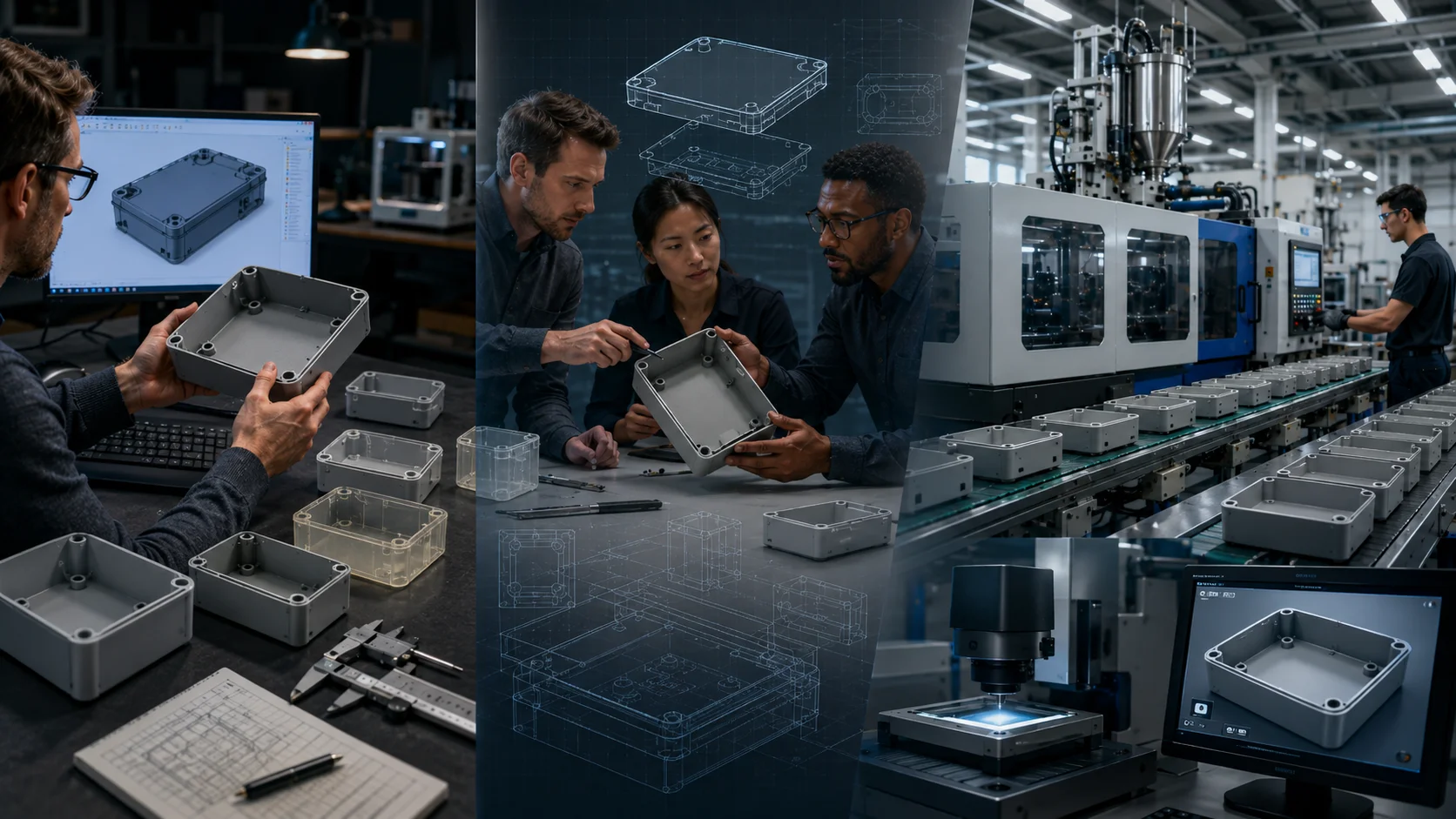
Perfectly working for your 3D printed prototype. Now what? The transition to volume production requires proper planning and designing for manufacturing (DFM) review of your prototype which identifies features that work perfectly for 3D printing but will not be an issue with injection molding. Wall thickness, draft angles and undercuts will all require some consideration in order to produce a quality product. The physical properties of both processes might actually differ slightly in some respects between the two processes if made from the same type of base material (ABS, PC, etc.). There are often stricter testing requirements of finished goods than there were of prototypes. The added complexity of needing to perform environmental testing, validate an IP rating, and certify compliance can be difficult to navigate. At IDIS India, we work collaboratively with our customers as they make this transition seamlessly and successfully with our injection molding expertise. Our goal is to ensure that the production enclosures maintain all of the same functional attributes and characteristics as demonstrated in the prototype. Want to transition from concept to production? Contact our team today to discuss your enclosure 3D printing requirements and together, we will help recommend the best technology, optimize your design and formulate your path to volume production. Whether you have 5 prototypes or 500 low-volume units, we have the in-house capability to support your project timeline.
Need Help Choosing the Right Enclosure? Get in Touch!