
Polycarbonate Enclosures are ideal for providing excellent optical transparency and look great and are incredibly durable outdoors in highly demanding industrial environments. When you need to protect your sensitive electronics while still being able to see them, polycarbonate enclosures have excellent optical clarity and UV resistant properties. Polycarbonate enclosures are very strong and ideal for being in sunny locations, such as solar monitoring applications, human machine interface displays, and outdoor metering applications, where presence of protection and visibility are both very important. IDIS manufactures our polycarbonate enclosures from UV stabilized materials, so they’ll maintain clarity and strength after years of being exposed to the outdoors. IDIS’s I-Closure polycarbonate series offers four degrees of ingress protection (IP65, IP66, IP67), as well as seeing your important components with exceptional clarity.
Transparency Grades in Polycarbonate Enclosures
The level of transparency that a polycarbonate enclosure provides is variable. The resin grade and how it’s manufactured determines how clear it is. A clear polycarbonate typically transmits between 89 – 92 % of light – providing almost the same amount of clarity as glass – making it an excellent choice for HMI displays and touch interfaces. When using a clear polycarbonate to view a digital display, you will be able to clearly see the display even when it’s in direct sunlight. One thing engineers often overlook is the thickness of the polycarbonate enclosure will affect how clear the enclosure is. For example, a 2mm wall will provide better clarity than a 4mm wall at the risk of sacrificing some impact resistance. Translucent grades transmit between 60 – 75 % of light, and due to their slight haziness, they work well as a status indicator LED and general visibility applications where there isn’t a necessity for perfect clarity. The slight diffusion of the light in some designs with LEDs will help reduce hot spots. Tinted polycarbonate reduces glare while providing reasonable visibility. The most popular tints for outdoor displays that will be exposed to high amounts sunlight are grey and bronze. The tinting does not detract from the UV stability of the polycarbonate; in fact it increases the UV stability.
UV Stabilizer Technology in PC Enclosures
Over time, UV radiation degrades polymer chains resulting in yellowing, cracking and loss of strength. As a result, UV stabilizer additives are included in quality polycarbonate enclosures. The UV absorbers used by IDIS India convert UV energy into non-harmful heat. These additives are mixed in throughout the material, not just on the surface coating where they can wear off. Our PC formulations usually contain 0.2-0.5% loading of a UV stabilizer, depending on anticipated exposure levels. What type of UV stabilizer is used is also important. Benzotriazole absorbers work well for indoor/outdoor applications, while hindered amine light stabilizers, (HALS), provide long-term protection for extremely long-term outdoor applications such as solar installations. In addition, UV stabilization impacts the manufacturing process, with stabilized grades of material requiring a slightly higher melt temperature, which is taken into consideration by our injection molding teams when determining cycle parameters.
Outdoor Exposure Testing
So how can you determine whether your polycarbonate enclosure has the ability to maintain its properties when used outdoors? Accelerated weathering tests have been developed to simulate many years of outdoor use in just a few weeks. For example, Xenon arc testing performed in accordance with ASTM G155 exposes samples to controlled ultraviolet (UV), temperature and humidity cycling. QUV test use fluorescent UV lamps, enabling focus on UV degradation alone. Will this test method be applicable as validation of outdoor construction? Yes. Based on actual Florida weather (Example: actual outdoor service over all or part of 12 to 24 months), a determination may be made that your product has met and continues to comply with that specification as demonstrated above. In addition, our UV-stabilized polycarbonate (PC) compounds typically experience less than 5% loss in strength after 2000 hours of Xenon ARC (equivalent to about 2 to 3 years of outdoor use).
Optical Clarity Retention Over Time
Initial transparency is an indication of quality, but it does not give a complete picture of how long polycarbonate will remain clear after spending months or years outdoors. Unstabilized polycarbonate will become noticeably yellow after 6 to 12 months of exposure to the elements. As UV exposure continues, the yellowness index of unstabilized polycarbonate will go from less than 2 to over 15; this would also be enough to turn white displays a dingy yellow.
UV-stabilized quality polycarbonate will have an average yellowness index of less than a value of 5 after considerable exposure to UV radiation. However, there are many other environmental factors that affect the retention rate:
Higher temperature fosters more rapid yellowing; therefore, polycarbonate enclosures set up in deserts will have a shorter service life than those located in areas with temperate climates. Industrial air pollutants may contribute to accelerated aging of polycarbonate due to their interaction with UV radiation. High-stress concentrations around areas such as mounting holes or sharp corners will yellow more rapidly than other areas.
Consider the installation environment when identifying polycarbonate enclosures and their suitability for optical applications — everything else being equal, a solar monitoring station in Arizona will require more UV stabilizer than a metering cabinet in Germany.
Impact Resistance for Harsh Environments
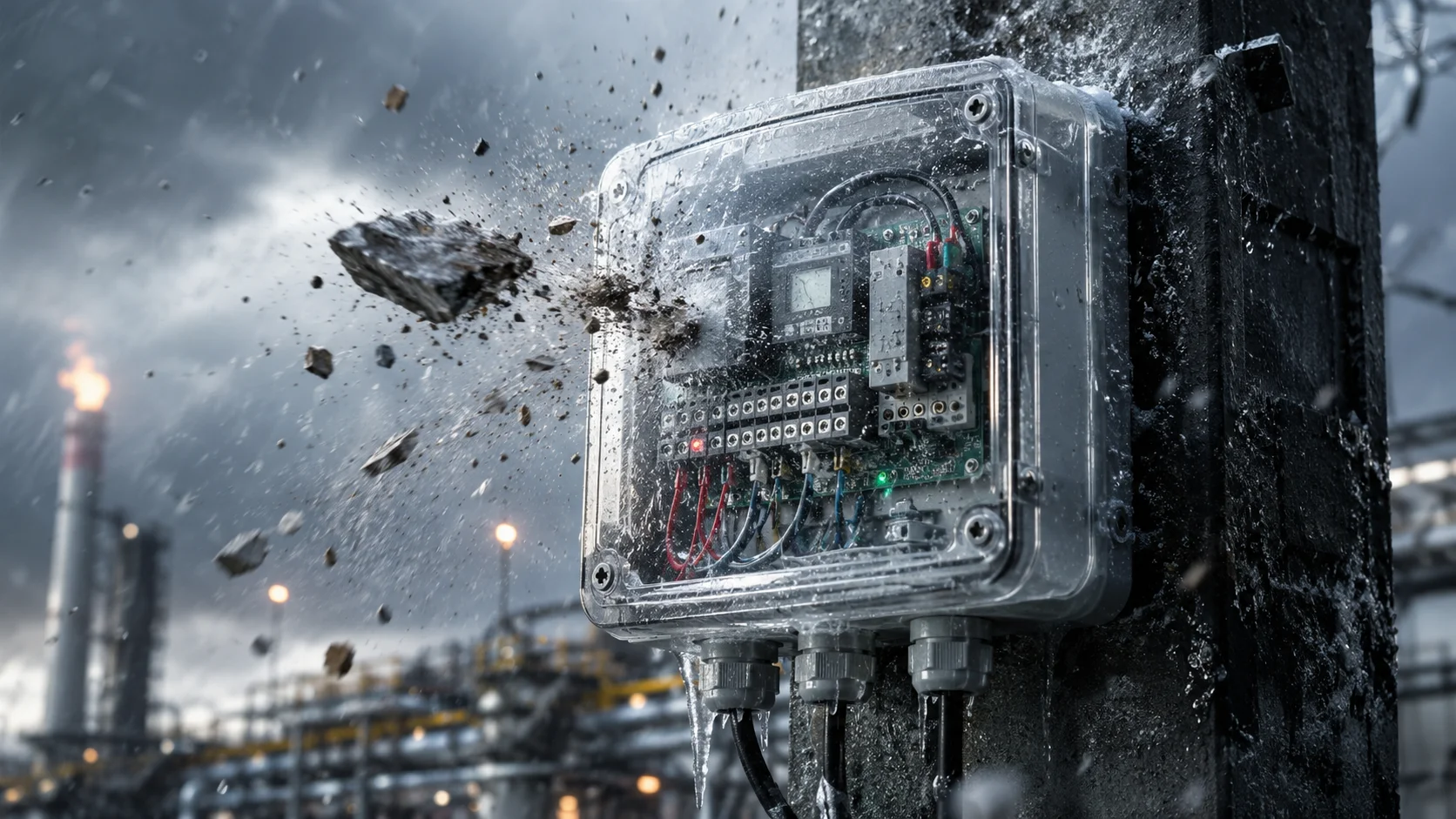
Polycarbonate is known for its exceptional durability, making it a great choice for outdoor enclosures that will encounter impacts and be exposed to extreme temperatures and other forms of mechanical abuse. Standard grades of polycarbonate have a minimum impact resistance ranging from 600 – 900 J/m, which is approximately 10 times greater than an equivalent ABS material; therefore, it can be expected that a polycarbonate enclosure will have an impact rating of IK08 or IK10. This means that a polycarbonate enclosure should be able to withstand hammer strikes of five to 20 joules before fracture occurs. However, the resistance of polycarbonate to impact is not consistent at all temperatures, as polycarbonate will maintain its ability to handle a wide range of impacts at temperatures as low as -40°C; other thermoplastics can become brittle at low temperatures. Therefore, this ability to stay tough and maintain sufficient impact resistance makes polycarbonate a desirable material for outdoor applications, regardless of climate conditions — be it arctic or tropical. Notched portions of the enclosure are more prone to being damaged than unnotched portions. To reduce the impact loading on the notched portions of the enclosure, I-closure designs use gentle curves and eliminate sharp corners on the interior of the enclosure — thus maintaining the maximum impact resistance of polycarbonate.
HMI Display Protection Applications
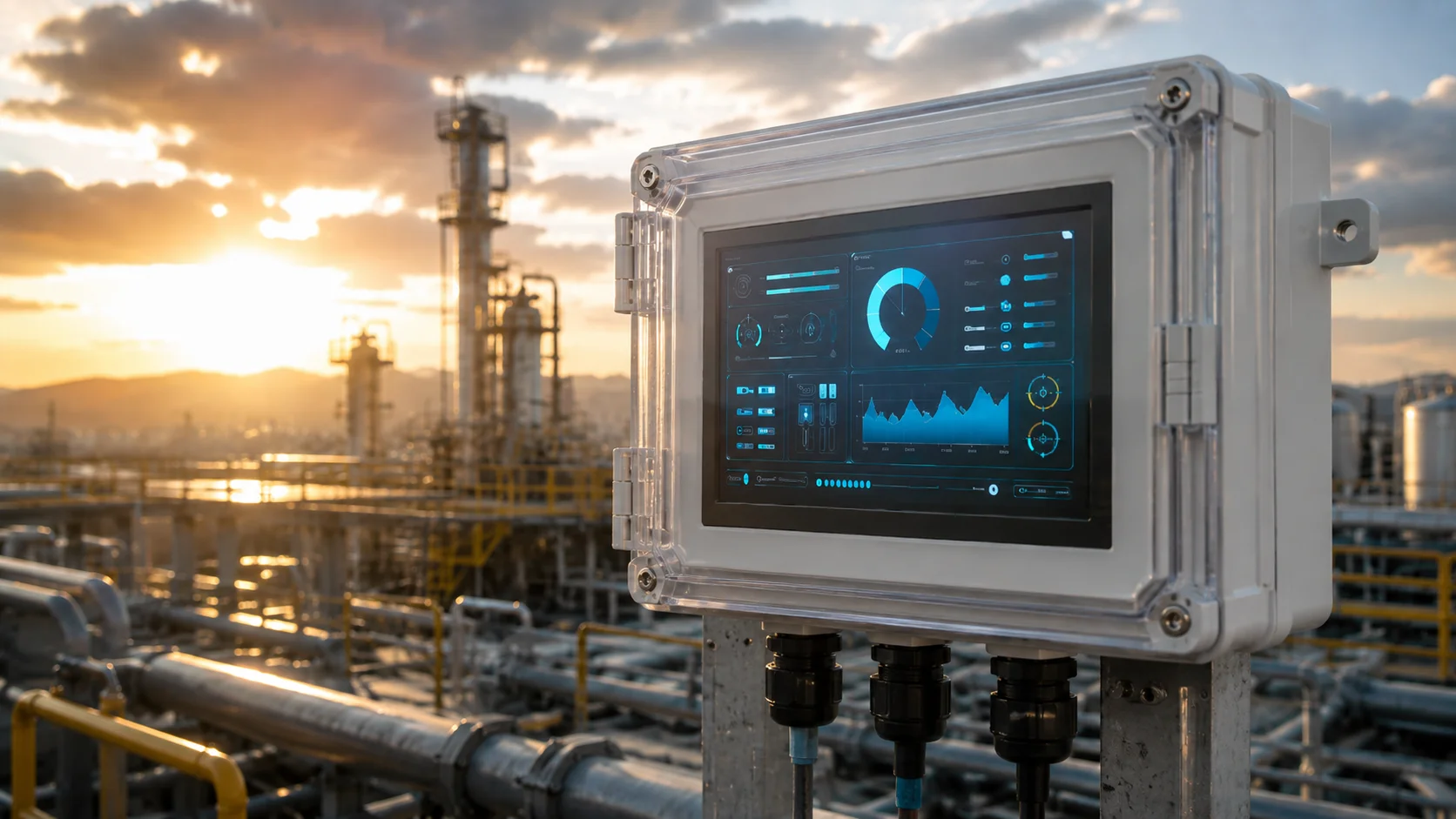
An effective interface between humans and machines must provide adequate visibility and protection. Polycarbonate enclosures are a great solution for these types of applications. A touch screen requires optical clarity, as well as scratch resistance. The hardness of the PC will not allow any keys to leave a scratch mark while still providing transparent viewing. Anti-glare coatings are available for those who require them; however, these coatings may affect long-term UV stability of the device. Having a clear enclosure will present many issues with regard to EMI (electromagnetic interference) shielding. While using transparent conductive coat paint may offer some degree of shielding, it will also diminish the optical clarity of the part. When designing a critical EMI application, be sure to use metallic gaskets and provide a proper ground design. Another issue to consider while designing an HMI enclosure is thermal management. Heat is generated from displays and needs to be dissipated properly to prevent the fogging of the enclosure. You can accomplish proper thermal dissipative properties through either design of proper ventilation or using sealed designs that incorporate thermal dissipative properties to eliminate condensation issues.
Display Mounting Considerations
The way that you mount a display will impact both its optical performance and reliability in the long run. Things to keep in mind while mounting displays would be to avoid putting a lot of pressure on areas that would create stress points and optical distortion, using flexible gaskets to allow for differences in thermal expansion, considering using removable display panels for accessing the service, and planning out the routing of the cabling to avoid sharp bends at the mounting points.
Solar Monitoring Equipment Housing
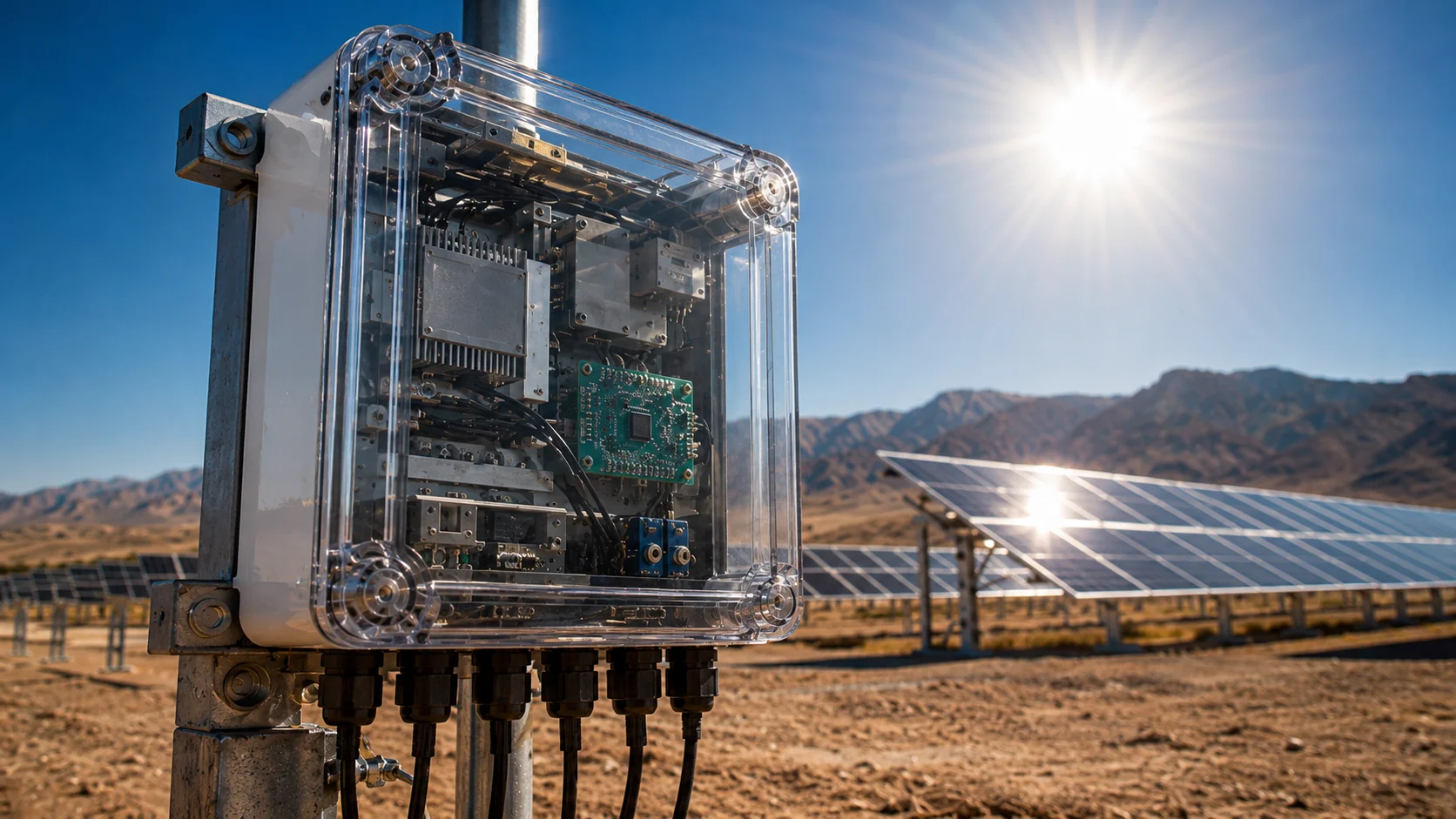
Solar panel installations are subjected to extreme challenges due to intense ultraviolet light, large variations in temperatures and a 20+ year service life requirement. Therefore, polycarbonate enclosures must be designed for specific conditions encountered by solar farms. The amount of UV sunlight found in solar farms is much greater than in other outdoor applications. In addition, the amount of sunlight that reaches the ground from mirrors used to track the sun can create extremely high surface temperatures, often exceeding 80 degrees Celsius (°C). Standard grades of polycarbonate generally do not have sufficient protection against solar UV radiation unless they utilize premium blue light UV stabilizers. IDIS India’s solar-grade polycarbonate is made with non-staining or transparent UV stabilizers that have been specifically developed for everyday use in photovoltaic applications and maintain their original optical clarity and mechanical performance after many years of solar radiation. Another significant issue caused by thermal cycling is the significant amounts of expansion and contraction that occur at mounting points and in gasket seals and result from thermal cycling. The lower the coefficient of thermal expansion (CTE) of a specific thermoplastic material, the lower the thermal stress at mounting points and gasketing seals. Therefore, the CTE of polycarbonate (approximately 65 x 10^-6 /°C) aids in minimizing these stresses compared with other thermoplastic materials.
Solar Monitoring Specific Requirements
A solar monitoring enclosure must have additional features when compared to an average outdoor entrance to withstand harsh environments such as lightning strikes, transmission signals, ventilation of batteries, grounding of structure, etc.; also keep in mind that solar facilities typically utilize aggressive cleaners to maintain them; therefore, the enclosure material and gaskets must withstand corrosive cleaning personnel without failure.
Weather Resistance Performance
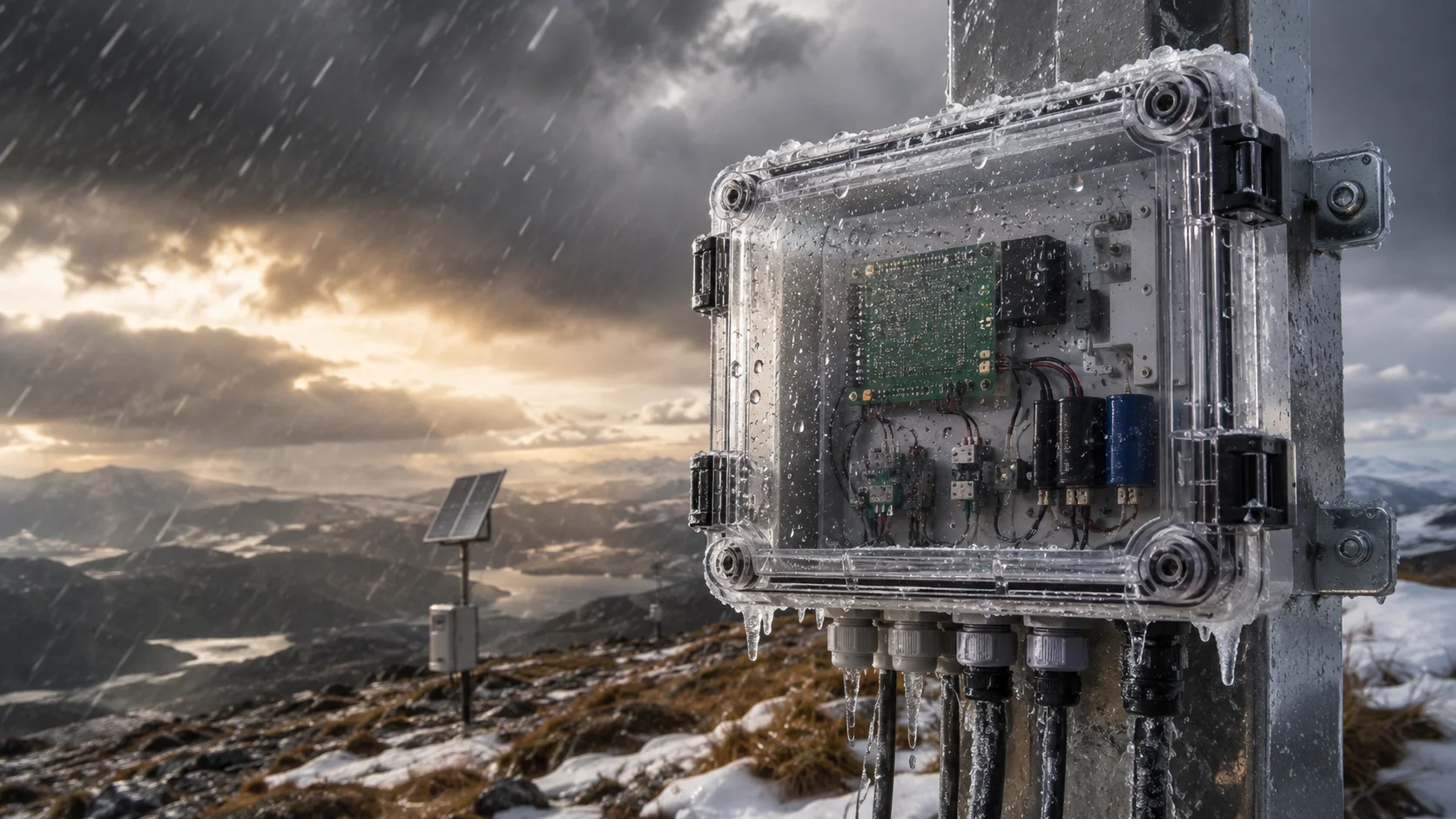
Besides the UV exposure, the outdoor polycarbonate enclosure is affected by other things, such as the rain, snow, ice and temperature extremes. All these elements have an impact on the long-term performance of the enclosure. Water absorption in PC is relatively low (0.15-0.35%), but moisture absorption can have an adverse effect on both dimensional stability and electrical properties. In order to minimize the effects of moisture-related warpage , the design of wall thickness and rib design is critical. Gasket seals and mounting hardware are subjected to freeze-thaw cycling within the enclosure system. While the toughness of PC allows it to withstand these extreme conditions, the other parts of the enclosure system (gaskets, fasteners, cable glands) must also be designed for thermal cycling. Stress concentrations caused by wind loading occur at the mounting locations of the enclosure. Therefore large enclosures should undergo structural analysis to verify the strength of all mounting tabs and internal ribs are sufficient to resist design wind loads without failure.
Regional Climate Considerations
| Climate Zone | Primary Challenges | PC Grade Recommendations |
|---|---|---|
| Desert | Extreme UV, thermal cycling | Premium UV package, heat-resistant |
| Tropical | High humidity, UV exposure | Standard UV grade, hydrolysis resistance |
| Arctic | Low temperature impact | Cold-impact modified grades |
| Industrial | Chemical exposure, UV | Chemical-resistant formulations |
Quality Standards and Testing
How can I verify that polycarbonate enclosures will meet my expectations for performance? Industry standards are established and tested for several areas, including UV resistance, impact performance, and weatherability. For the UV resistance of a plastic material, ASTM D1435 provides a standard test method. In conducting these tests at IDIS India, we follow the ASTM D1435 and ISO 4892 standards to ensure consistent measurement of weatherability. We usually test our polycarbonate samples by exposing them to 2000-5000 hours of UV radiation depending on the severity level of the application. For example, the IEC 62262 impact test method is used to determine the durability of our polycarbonate enclosures by measuring their mechanical strength. Our polycarbonate enclosures consistently achieve IK08 to IK10 ratings, making them an optimal choice for most applications that will be used outdoors. However, since these standards do not cover all environmental conditions that occur in real-world situations, we perform additional testing to evaluate applicationspecific performance based on your individual requirements. For example, to test the ability of our polycarbonate enclosures to resist thermal cycling in desert solar installations, we will conduct multiple thermal cycles before allowing them to be used in the application. Salt spray exposure must also be tested when evaluating our polycarbonate enclosures’ performance for marine applications. If you need a polycarbonate enclosure for a transparent outdoor application, please contact us at IDIS India so we can help you with your specific project requirements. Our engineering department will recommend the best grade of polycarbonate and design characteristics based on your environmental and performance needs.
Need Help Choosing the Right Enclosure? Get in Touch!