
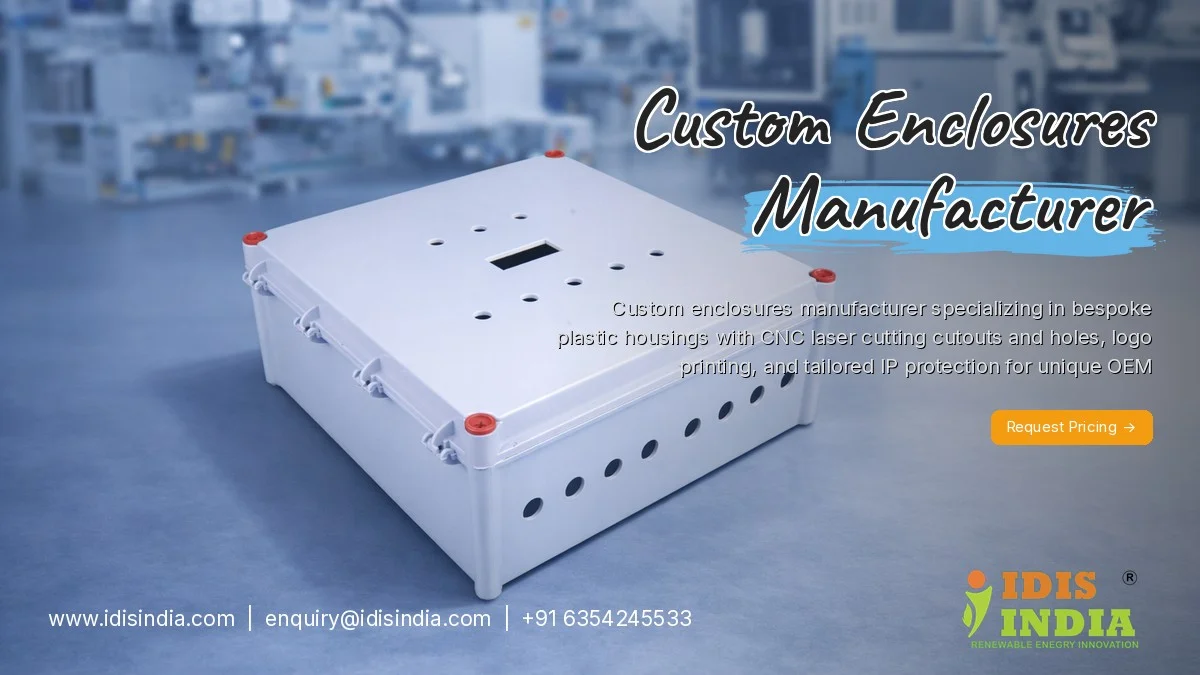
Looking for an enclosure that meets your specific requirements? Generic solutions do not always fit particular situations. This is where a custom enclosure manufacturer can help. IDIS India recognizes that each project is different. Project-based applications vary greatly, such as IoT devices developed for rugged conditions, medical devices with certain sterilization requirements, and electronics with strict tolerance levels. The range of manufacturing capabilities provided by IDIS will allow you to transform your vision into an actual product. Creating a custom enclosure is not only about changing existing enclosure designs but also knowing your application requirements, the restrictions that come with your application, and producing a custom enclosure that works perfectly.
Custom Enclosure Design Process
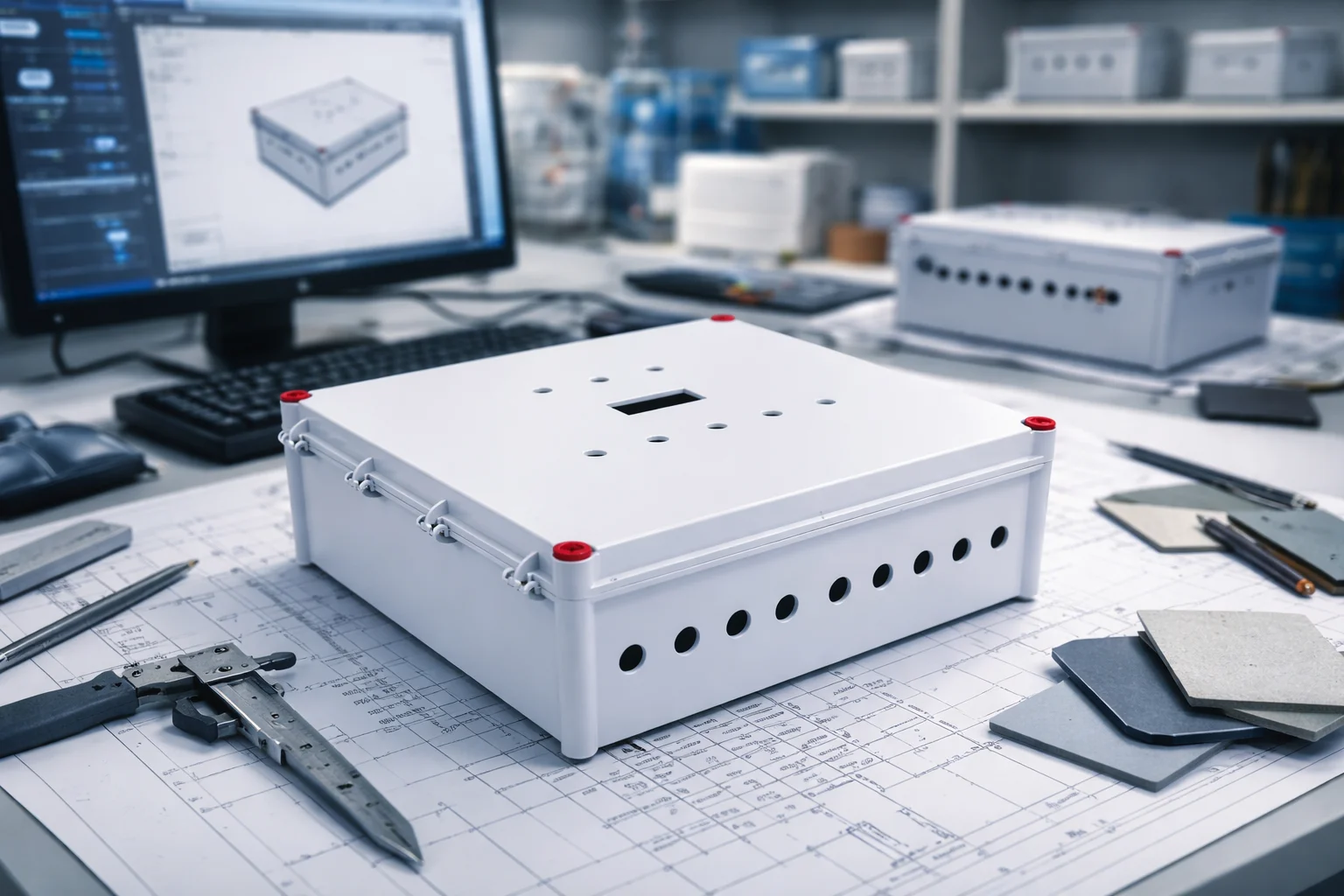
Are you looking to build a custom enclosure for your project? If so, the first step in the design process begins with understanding how and where the enclosure will be used. Our team will review the environment that the enclosure will be in to ascertain what materials will be used to construct your enclosure, as well as how to seal the enclosure. If the enclosure will be used outside, in high-temperature conditions or exposed to chemicals then those three parameters will drive the materials used and how the enclosure will be sealed. Our engineering team uses ABS, Polycarbonate, and PC/ABS to come up with an appropriate material solution for the enclosure that will meet your needs. After that, we determine the dimensional requirements of the enclosure itself. Although there are many standard enclosures available, those standards will only work for Applications that do not require precision-fit enclosures. In order to provide you with an enclosure that has the correct fit and function, our engineers will generate detailed technical drawings from your PCB layout, component clearances, and connector requirements. We will also discuss the appropriate IP (Ingress Protection) rating. All of our custom enclosures are manufactured to an IP65/IP67 rating, however, the specific IP rating your enclosure will require depends on your particular application. An indoor IoT device may only require an IP65 IP rating while outdoor medical devices require an IP67 rating. During the design process, we will also discuss any special color and finish requirements that you may have. If you want to have custom colored enclosures, textured finishes, or any surface treatments, we can accommodate those needs at the beginning of the design process rather than after the enclosure has been completed. We also provide documentation in the form of 3D models, technical drawings, and material specifications prior to progressing to the prototype production phase of the design process, allowing you to find any errors before creating the prototype and avoiding expensive changes later in the project.
Engineering & Prototyping Capabilities
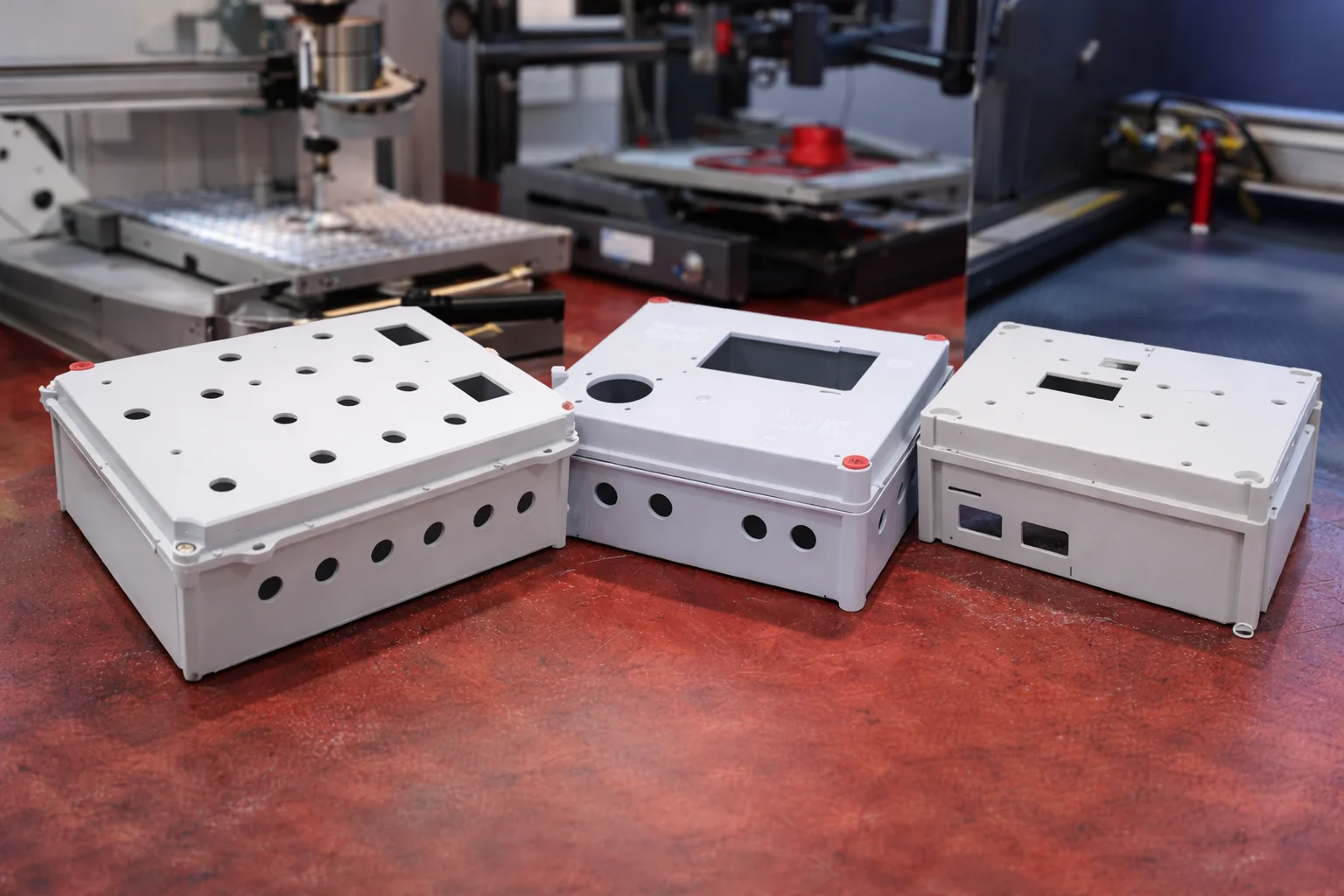
Are you able to evaluate how well your design works prior to investing in manufacturing? Yes! Our prototyping solutions allow for the ability to confirm that the design of your enclosure is sound (i.e., everything works together) before manufacturing the entire enclosure. Our prototype enclosures are made from solid blocks of material using CNC machining processes allowing for precision dimensional accuracy giving you an opportunity to evaluate fit, form and functionality. All custom features will typically be part of the prototype including cutouts, mounting posts, cable entries and sealing surfaces. Engineering validation includes dimensional verification, IP rating testing, and environmental stress testing will take place during this phase of development. We are able to check tolerances, verify that the enclosure is watertight and perform thermal testing under different environmental conditions. The prototyping process allows for design iterations to happen very quickly. For example, if you need to move a mounting hole, make a change to a cable entry, or change wall thickness, those changes can easily be done while we are creating the prototype. Throughout this process, you will receive ongoing technical support from our engineering team. We have been involved with hundreds of customized projects and will help identify any potential issues that may arise during manufacturing and suggest design changes that could help save you money while maintaining the same level of performance from your enclosure. During prototyping, Material Testing will occur. We will determine the chemical resistance, UV stability, thermal performance and mechanical strength of each material based on your application requirements.
CNC Machining & Modification Services
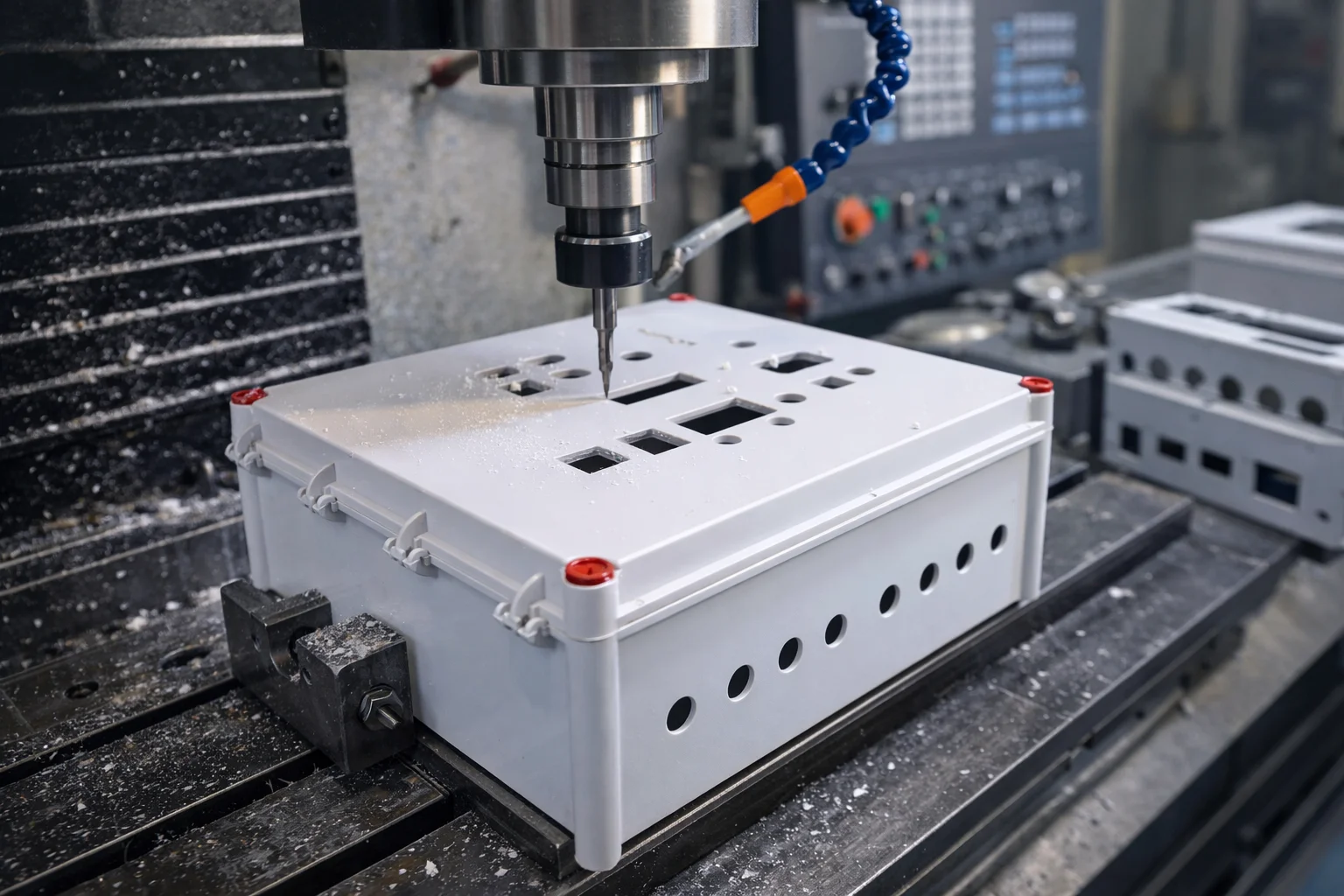
CNC Machining can be used to enhance existing designs or create new structures from solid materials when standard enclosures are almost ideal but require the addition of features. The precision of CNC Machining allows us to achieve very tight tolerances, complex geometries, and create custom mounting features, cable entries, heat dissipation fins and custom cut-outs for connectors, all of which can be achieved to an accuracy of typically ±0.1mm on critical dimensions. We are also capable of machining complex internal features into the enclosures using CNC machining. For example, if you need to machine custom mounting posts in a specific location, internal cooling channels or specialized PCB guides directly into the enclosure walls. The machinist has the option to finish the machined surface by creating smooth machined surfaces, producing textured patterns and preparing the enclosure for specific coatings. Depending on your application the machined surface can be finished to a smooth finish for easy cleaning in the medical industry or to a textured finish for additional grip when using handheld devices. Secondary operations such as threading, heat staking and ultrasonic welding can be completed on CNC Machined Enclosures. This provides for intricate assembly and secure mounted components. CNC Machining is a practical solution for a low to medium volume of production where the tooling costs are to be minimized. Therefore for larger production runs, we will typically recommend to develop tooling for better economics.
Custom Printing & Branding Options
How do you make your enclosures instantly recognizable? Custom printing and branding transform plain enclosures into professional-looking products that reflect your brand identity.
Screen printing offers durable graphics that withstand harsh environments. We can print logos, part numbers, warning labels, and operational instructions directly onto the enclosure surface. Screen printing works well for simple graphics and text in limited colors.
Pad printing enables precise graphics on curved or irregular surfaces. This technique works well for small details like LED indicators, button labels, or connector markings. Pad printing maintains sharp detail even on complex surface geometries.
Laser engraving creates permanent markings that wont wear off. This method works particularly well for serial numbers, compliance markings, and detailed technical information. Laser engraving can create both surface markings and deep engravings depending on requirements.
Custom labels offer flexibility for frequently changing information. We can apply pre-printed labels or provide enclosures ready for your labeling process. Label areas can be designed with specific surface treatments for better adhesion.
Color matching ensures your enclosures align with brand guidelines. We can match specific Pantone colors or provide color samples for approval before production.
| Customization Option | Best For | Durability | Color Options |
|---|---|---|---|
| Screen Printing | Large graphics, logos | Excellent | Up to 4 colors |
| Pad Printing | Small details, curved surfaces | Good | 1-2 colors typically |
| Laser Engraving | Permanent markings, fine detail | Permanent | Natural material color |
| Custom Labels | Variable information | Good with proper adhesive | Full color available |
| Custom Molding | High volume production | Integral to material | Any moldable color |
Mould Development for New Designs
When to Order Custom Moulds When your quantities are large enough, or if your product design contains features that are not easily manufactured by CNC machining, developing a custom mould will typically be the most economical option. The moulding process begins with the prototype approved for production. We create mould design specifications based on the proven enclosure design to ensure optimum material flow, proper venting and quality of the finished part.
The mould design process generally includes a mould flow analysis to determine the best gate location and identify potential issues. A single cavity mould will work well for most applications that are not very high volume. A multi cavity mould will provide lower per part cost a high volume production run but will require a higher initial investment. Depending on your volume projections and schedule requirements, you will need to determine the type of mould to order.
With the mould design you will develop the proper draft angles and wall thicknesses. Correctly designed draft angles will provide for ease of part ejection with minimal damage to the finished part and consistent wall thickness will help prevent warpage as well as avoid concentration of stress in the finished piece.
Correctly designed mould textures and finishes will also be built into your mould. If you require smooth finishes for easy cleaning, textured surfaces for improved grip, or specific looks, the mould will be manufactured to create these features per your specifications.
The mould validation process will include First Article Inspection, Dimensional Verification, and Production Samples. We will verify material properties, cycle times, and consistent parts produced prior to approving the mould for production. We can use these same test results to modify the mould at the time of evaluation. Design improvements to the original mould can be accomplished using actual production samples to improve the quality of the part and/or modify the dimensions or features of the mould.
MOQ & Pricing Structure
What are the minimum quantities for custom enclosures? MOQ requirements vary significantly based on the customization level and manufacturing method chosen.
CNC machined enclosures typically have lower MOQs since no tooling is required. Quantities starting from single pieces up to several hundred make economic sense for CNC production. This approach works well for prototypes, low-volume specialty products, or when design changes are likely.
Modified standard enclosures fall between CNC and moulded options. Simple modifications like custom cutouts or mounting holes can be performed on relatively small quantities while maintaining reasonable pricing.
Custom moulded enclosures require higher MOQs to justify tooling costs. The exact quantity depends on part complexity, mould requirements, and material specifications. However, per-part costs decrease significantly with moulded production.
Pricing factors include material selection, complexity level, tolerance requirements, surface finish specifications, and production volume. ABS enclosures generally cost less than polycarbonate or PC/ABS combinations, but material selection should be based on application requirements rather than cost alone.
Additional services like custom printing, special packaging, or quality certifications affect pricing structure. These services add value but need to be factored into project budgets.
| Production Method | Typical MOQ Range | Setup Costs | Unit Cost Trend |
|---|---|---|---|
| CNC Machining | 1-500 pieces | Low | Higher per piece |
| Modified Standard | 25-1000 pieces | Medium | Moderate per piece |
| Custom Moulding | 500-5000+ pieces | High | Lower per piece |
| Standard + Printing | 50-2000 pieces | Low-Medium | Moderate per piece |
Project Timeline from Concept to Delivery
How long does custom enclosure development take? Timeline varies based on complexity level, but understanding the phases helps with project planning.
Initial consultation and requirements gathering typically takes 1-2 weeks. This phase includes application analysis, material selection, dimensional requirements, and feature specification. Thorough requirements gathering prevents delays later in the process.
Design and engineering phase duration depends on complexity. Simple modifications might take 1-2 weeks, while complex custom designs can require 4-6 weeks. This phase produces detailed drawings, 3D models, and manufacturing specifications.
Prototyping timeline varies by method. CNC prototypes are typically ready within 2-3 weeks of approved drawings. More complex prototypes requiring special tooling or materials may take longer.
Testing and validation adds time but prevents production issues. IP rating testing, environmental testing, and fit checks typically require 1-2 weeks depending on test requirements.
Mould development represents the longest single phase for custom moulded enclosures. Mould design, manufacturing, and validation typically require 8-12 weeks depending on complexity. However, this investment pays off in reduced per-part costs for higher volumes.
Production timeline depends on quantity and manufacturing method. CNC production might take 2-4 weeks for moderate quantities, while moulded production can often be completed within 2-3 weeks once moulds are validated.
| Project Type | Design Phase | Prototyping | Production Setup | Total Timeline |
|---|---|---|---|---|
| Simple Modification | 1-2 weeks | 2-3 weeks | 1 week | 4-6 weeks |
| CNC Custom Design | 3-4 weeks | 2-3 weeks | 2-3 weeks | 7-10 weeks |
| Custom Moulded | 4-6 weeks | 2-3 weeks | 8-12 weeks | 14-21 weeks |
| Standard + Custom Printing | 1-2 weeks | 1 week | 2-3 weeks | 4-6 weeks |
Working with I-closure for Custom Solutions
Would you like to talk about your needs for a customized enclosure? Our team has extensive experience working on different types of devices such as IoT devices, medical equipment and other specialized electronics applications. The first step in any custom development project is to analyze the application fully. By understanding the operating environment, performance requirements & constraints, we can provide you with the best solution. This is a very important part of the project and is essential for its success. All of our processes have been certified to ISO9001 standards, so we can guarantee consistent quality during all phases of production and development. In addition, your enclosures will be CE & RoHS compliant (globally accepted standards for electronic enclosures). You will receive regular updates and review sessions regarding the progress of your project and any technical help that you may need while your project is underway. We believe that development should involve teamwork, so your input will greatly influence the end result of your product. After delivery, we provide support by helping you plan for production scalability, modifying designs and continuously managing supply. Custom enclosures are constantly evolving as the products for which they are made mature and we will help you make that transition. Please call IDIS India today to see how our engineering team can assess your application & give you the most suitable options for customizing your enclosure based upon your needs and budget.