
Selecting the right junction box is more than just finding the least expensive one on the shelf. The choice you make will determine the installation time, maintenance expense, and the overall reliability of the junction box over its lifespan. The wrong junction box can cause you problems later in time when you have wired a panel or when you are troubleshooting field connections. The goal of this guide is to provide readers with basic guidelines for selecting junction boxes. We will cover the different types of junction boxes, the materials used to manufacture junction boxes, how to size a junction box, as well as providing you with some practical tips for installing the junction box. At the end of this guide, you should have a basic understanding of how to select the right junction box for your project.
Types of Junction Boxes for Different Applications
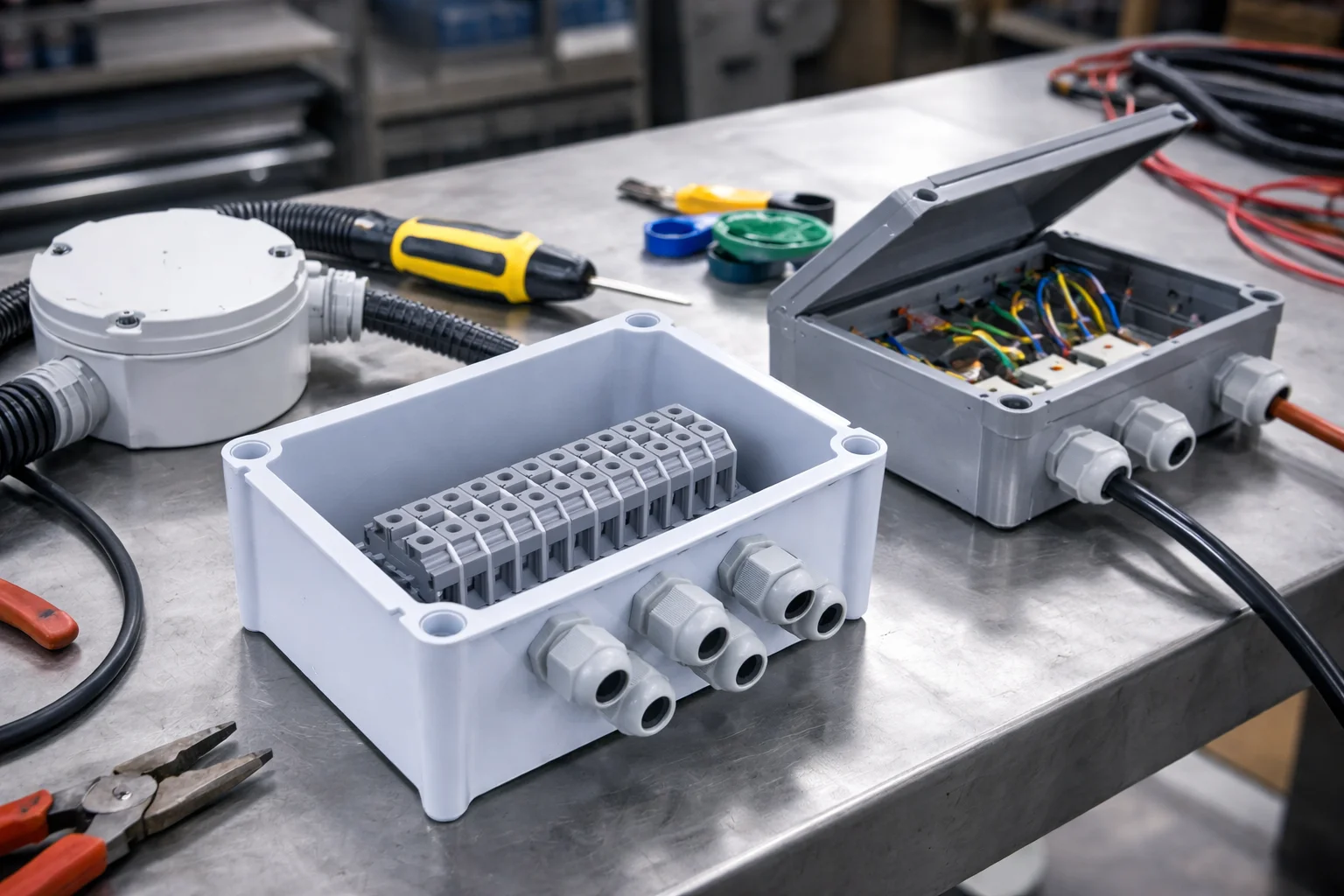
Junction boxes come in several configurations, each designed for specific wiring tasks. Understanding these types helps you match the right box to your application.
Standard Terminal Junction Boxes
You will find these junction boxes to be quite useful in your collection of tools. Each box has multiple terminal blocks (removable blocks) allowing connections to multiple wires. Electrical contractors use these in general distribution work as well as field wiring. Standard terminal boxes are normally used for the following: Connection of control panels Wiring field devices Distributing signals Distributing power (within certain amperage limits). We offer various sizes for use in I-CLOSURE with terminal block counts typically starting small & scaling based on the required number of terminals.
Feed-Through Junction Boxes
Feed-through boxes lack internal terminal components, and rather are simply a protected area for performing wire nuts, splice connectors, etc. The feed-through box installations are simple; however, require more installation effort than an exit box. When using feed-through boxes you must have one of the following: Custom means of connecting. Specialized connector types. Budget restrictions that require a simplified approach. Need for temporary connections.
Multi-Compartment Junction Boxes
These boxes feature internal dividers that separate different circuits or voltage levels. This design prevents accidental contact between incompatible systems and helps meet electrical code requirements.
Multi-compartment boxes are essential for:
| Junction Box Type | Best Applications | Material Options | Typical IP Rating |
|---|---|---|---|
| Standard Terminal | General wiring, distribution panels | ABS, PC, PC/ABS | IP65, IP67 |
| Feed-Through | Custom connections, temporary wiring | ABS, PC | IP65, IP67 |
| Multi-Compartment | Mixed voltage, safety applications | PC, PC/ABS | IP65, IP67 |
| DIN Rail Mount | Panel installation, modular systems | PC/ABS | IP65 |
Terminal Configuration Options and Connection Methods
How easily you can connect up your wires and how long they will stay connected, all depends on the way the junction box is wired.
Spring-Clamp Terminals
When you insert a wire into spring terminals, the terminal automatically grips the wire with the use of springs. Springs grip the wires instead of screws, and therefore no tools are needed to make the initial connection. By using spring terminals, you can install the wire more quickly and reduce the chances of loose connections. Spring terminals work great with: Solid copper conductors Stranded wires with ferrules Quick installations High-vibration environments The only drawbacks to using spring terminals: You may not be able to use larger conductors with them, and there are some electricians who like to feel secure by having a firm grip on the conductor.
Screw-Type Terminals
The way that traditional screw terminals hold wires in place is by using a nut and bolt to tighten down on the wire. Because you have the ability to control how tight the nut is with the bolt, these terminals are able to hold more than one type of wire or size of wire together. Some examples of where screw terminals are used include: Large wires, multiple types of wire in one place, high current loads, and when you need to visually see how tight it is connected.
Barrier Strip Configurations
Barrier strips replace individual terminal blocks in some junction boxes by providing multiple connection points on a single strip in a limited amount of space. They are ideal for situations where there is not enough space to use individual connectors (i.e. if there is limited vertical height) but you want to have uniform spacing between all the connections. Additional uses of barrier strips would include control circuit applications, and when documentation and labeling must be easy to read.
Sizing Methodology and Internal Space Requirements
By correctly sizing, you avoid overloading equipment or creating a heat build-up; hence, making maintenance easier in the future. How do you determine the appropriate size?
Wire Fill Calculations
To begin with, size the count of conductors/wires you will use; it will vary by each manufacturer. Each conductor needs room for not only the conductor but also for bending radius and dissipating heat; if the connection is too tight it will have periodic failures and make troubleshooting very difficult. An overall approach is to Count all the conductors which will be entering the box Add the amount of space required for splices and/or connections Add an allowance for the bending radius Note when heat is generated from the connection. The connections you will use and the conductor schedule you have can be determined by reviewing all the items above and calculating how much space is required. IDIS India can assist you with calculating the amount of space required.
Terminal Count Planning
How many terminals do you need now? More importantly, how many might you need later? Adding terminals to an existing installation often costs more than specifying a larger box initially.
Plan for:
| Box Size Range | Typical Terminal Count | Recommended Applications | Cable Entry Options |
|---|---|---|---|
| Small (approx. 80-120mm) | 4-8 terminals | Simple field connections | 2-4 cable entries |
| Medium (approx. 150-200mm) | 8-16 terminals | Distribution panels, control boxes | 4-8 cable entries |
| Large (approx. 250mm+) | 16+ terminals | Main distribution, complex wiring | 8+ cable entries |
Access and Maintenance Space
When it comes to installing a junction box, the internal space is important in order to allow enough room for you and your tools. The tight quarters you have will make it difficult to install, and potentially dangerous to maintain, equipment installed in these areas (i.e., maintenance). Consider the largest tool you’ll need to use inside the box. In order to be safe, leave room for the following: access of the screwdriver to all terminals; strip and prepare your wires; use your multimeter probes; and visually inspect all your connections.
Cable Entry and Gland Selection Strategy
The weakest link in your enclosure system, in many instances, is at the cable entry point. Choosing the wrong type of cable entry gland can result in water entering and/or dust contaminating the enclosure and/or damaging cables within the enclosure.
Gland Types and Applications
Glands for various cables need to be designed differently. The armor on an armored cable must fit perfectly when terminated with glands. Unarmored cables require environmental sealing and a method for relieving strain. Glands must be sized according to: type of cable (either armored or unarmored) diameter of cable range environmental conditions required for IP ratings I-closures of standard metric and PG threaded glands within junction box sizes/types/conditions. Depending on the specific size and configuration of each box, each specific type will be compatible with a specific type of gland.
Entry Location Planning
Where should cables enter your junction box? This decision affects installation ease, weather protection, and maintenance access.
Consider these factors:
- Cable routing from source to box
- Avoiding water traps
- Keeping entries away from terminal areas
- Future cable additions
Most junction boxes offer multiple entry options. Some have pre-molded entry points, while others use knockout sections that you remove as needed.
| Cable Type | Recommended Gland Type | Key Features | IP Rating Capability |
|---|---|---|---|
| Unarmored PVC | Standard cable gland | Strain relief, environmental seal | IP65, IP67 |
| Armored cable | Armor termination gland | Armor clamping, earth continuity | IP65, IP67 |
| Flexible conduit | Conduit adapter | Thread compatibility, sealing | IP65 |
| Multiple small cables | Multi-cable gland | Individual sealing, space efficiency | IP65, IP67 |
Installation Methods and Wiring Best Practices
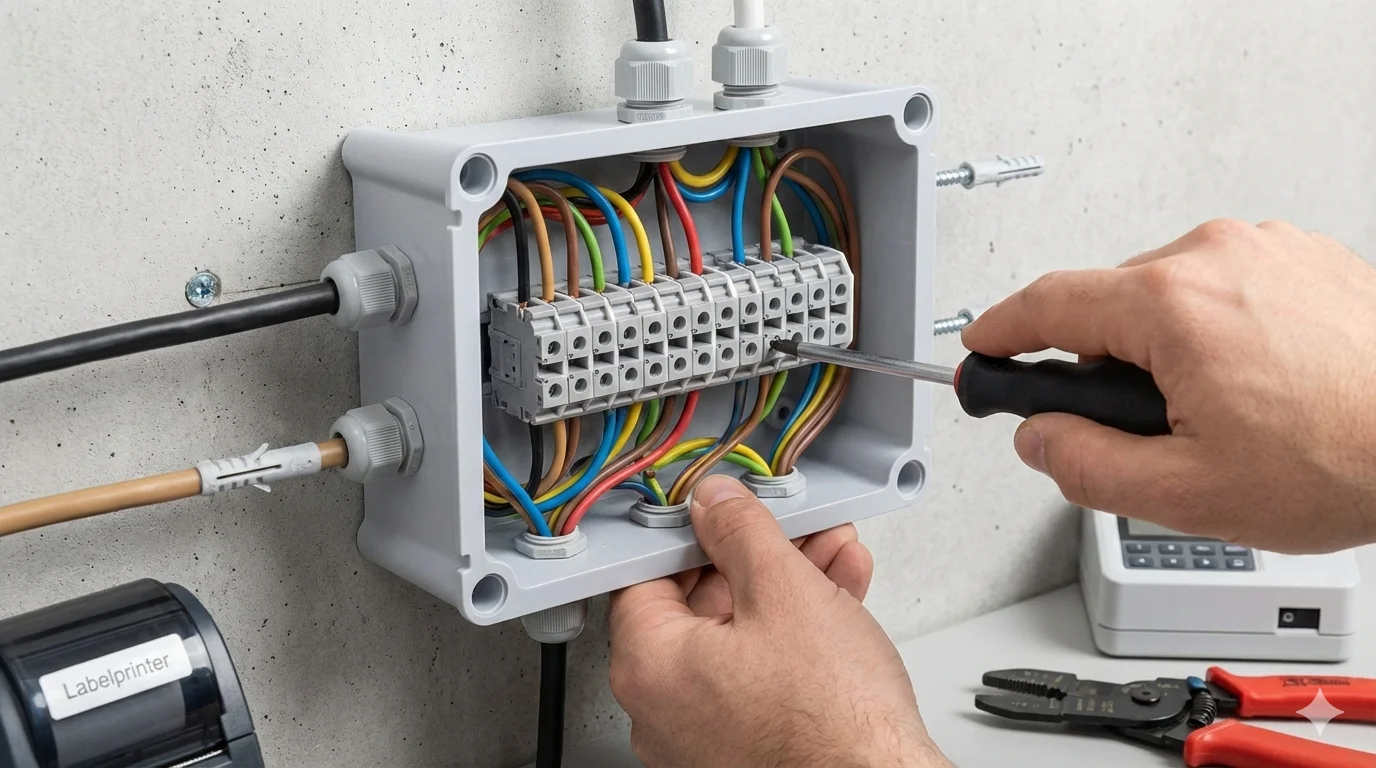
Even the best junction box can fail if installed improperly. Following proven installation practices protects your work and reduces callback visits.
Mounting Considerations
Junction box performance and longevity are affected by how and where you mount them. Outdoor installations pose a different set of challenges compared to indoor panel rooms, particularly:
– the adequacy of support necessary to support the weight of the junction box plus the weight of the cables – the orientation of the junction box to allow for the proper shedding of rainwater – access to junction boxes for installation/maintenance purposes – using vibration isolation mounts for box applications (where required).
In most cases, you will use wall-mounted junction boxes; however, you may also want to consider using pole attached junction boxes or other forms of installing (depending on individual circumstances). All forms of mounting junction boxes come with mounting hardware recommendations from IDIS India on each junction box type.
Wiring Organization Inside the Box
Having tidy and neat wiring is not simply to look good, but is also easier to find problems with, modify, and perform maintenance on. Furthermore, by reducing potential for accidental damage while performing work.
Some of the good practices that’s followed when wiring S are:
– Keeping related circuits grouped together – Using the same path for routing wires – Allowing service loops for future installations – Labeling circuit connections clearly
Some of the electricians use either cable ties or wire duct in junction boxes to help keep all their wires together so regardless of how many people work on the project they should remain organized with.
Testing and Commissioning
Verify that everything is functioning properly before closing the junction box. Following this procedure will help you avoid costly troubleshooting later. Verify the following: ensure there is continuity on all connections; verify proper polarity where applicable; ensure there is insulation resistance across voltage circuits; validate gland seals and IP ratings; document testing results. This documentation will be of great use to future maintenance teams as they will provide baseline measurements for future comparison.
Industry-Specific Junction Box Requirements
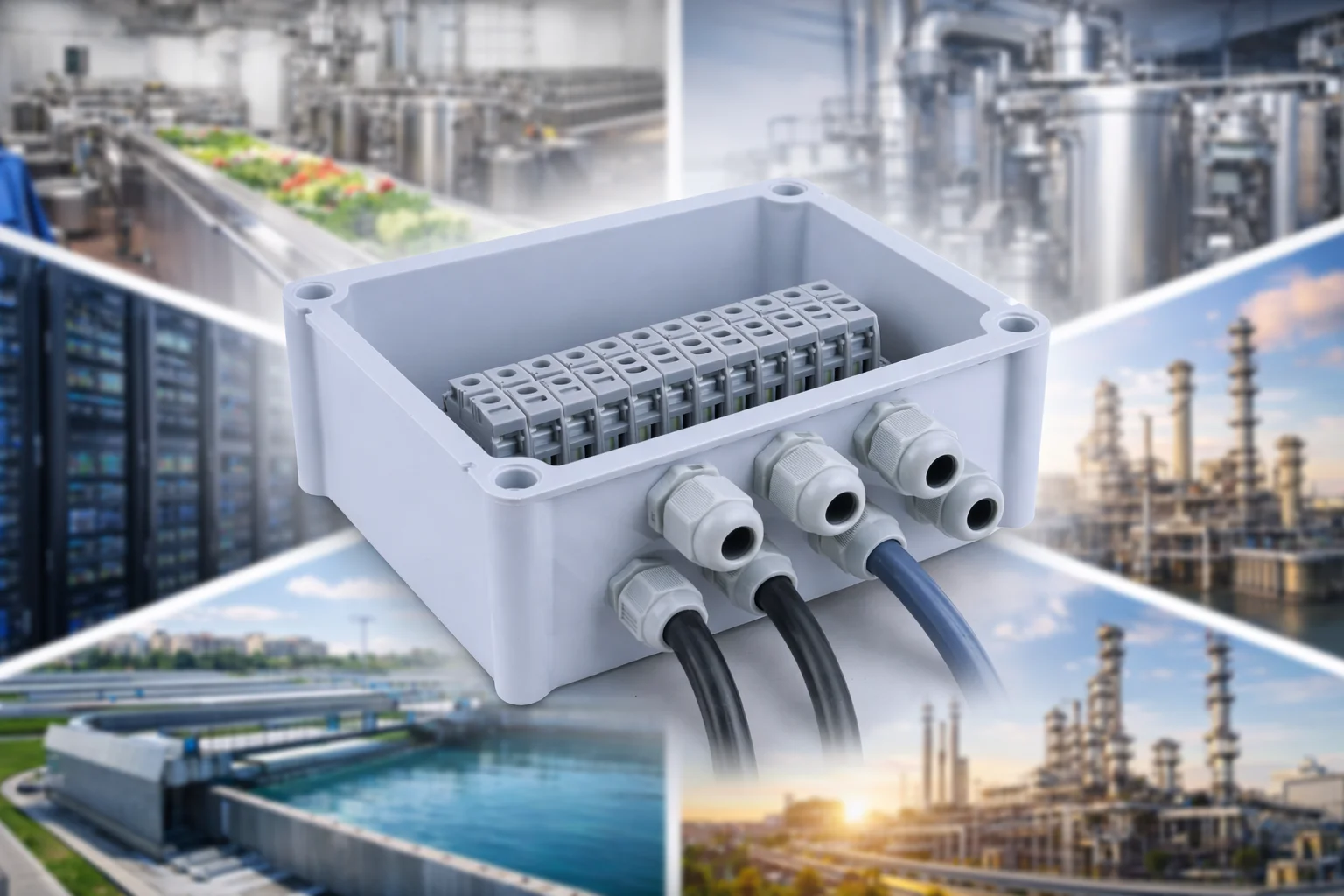
Each industry has different requirements that affect how junction boxes are chosen. What would work in an office building may not be appropriate in a chemical processing plant.
Food and Beverage Applications
Food process facilities require smooth surfaces, chemicals that will not damage the product, and ease of cleaning. When installed in these facilities, junction boxes are usually exposed to frequent washdowns with sanitising chemicals. When sourcing a junction box for a food process application, look for:
– External surfaces that are smooth and without crevices – Materials that are chemical resistant – An IP67 rating to protect against washdown – Mounting configurations that do not create dirt traps
Generally, polycarbonate (PC) and polycarbonate/acrylonitrile butadiene styrene (PC/ABS) materials perform better than standard ABS when it comes to handling food-grade sanitising chemicals; however, be sure to verify compatibility with your cleaning chemicals.
Marine and Coastal Installations
Electrical devices are impacted by air containing salt, and to combat this effect in coastal and marine installations junction boxes must be able to withstand corrosion and retain their seals through a wide range of temperatures. Marine features of junction boxes should include: The use of corrosion-resistant materials, The use of UV-resistant materials, The use of sealants that will NOT allow moisture ingress due to wind driven rain, Mounting hardware that will not corrode. Generally speaking, PC and PC/ABS materials provide better performance in marine environments when compared to ABS materials. The additional expense of these materials usually offsets itself through longer service life.
Industrial Automation Systems
Automation systems typically contain high-voltage power circuits and low voltage control signals. The signal integrity and safety requirements created by these combinations result in unique junction box designs. When designing a junction box for an automated system, you should consider the following factors: separation of power and control circuits; electromagnetic interference (EMI) shielding if necessary; appropriate cable management for the various types of signals; accessibility for troubleshooting and modifications; and effective use of multi-compartment junction boxes. Multi-compartment junction boxes are often appropriate for automated systems, providing circuit separation and cabling organization, while housing everything in one enclosure.
Material Selection for Long-Term Performance
Making sure you understand the properties of each type of material will help you select one with the best combination of price and long term performance, and ultimately improve your decision-making.
ABS Plastic Characteristics
ABS provides strong impact resistance and acceptable chemical compatibility at an affordable price. It has many uses indoors and some outdoors. Applications for ABS include areas where: Price is the decision maker Indoor installations are in regulated environments Moderate temperatures range and Limited contact with chemicals and/or UV rays. However, the limitations of ABS should also be kept in mind. UV exposure for extended times will break down the material; additionally, some of the industrial chemicals could have negative effects on the product over time.
Polycarbonate Advantages
PC is more expensive than ABS; however, the benefits of PC include improved performance over ABS in applications that demand extreme performance. Compared to ABS, it has better resistance to impact and temperature extremes. Use PC for the following applications: exposed to UV light; experience a wide range of temperatures; subject to high impact; potential for chemical exposure.
PC/ABS Combination Benefits
The combination of polycarbonate and acrylonitrile butadiene styrene offers the advantage of having the good properties of both materials. The result is that you have a more affordable variation of polycarbonate that provides you with equal or better chemical resistance than ABS alone. PC/ABS is appropriate for: Indoor/outdoor application mixes Moderate chemical exposure Impact resistant application Value-conscious projects requiring superior performance than normal ABS.
Quality Standards and Certifications
Each junction box does not necessarily have the same quality standard. Being aware of the various certifications that exist will allow you to specify the correct product that will provide you with the expected performance. IDIS India has achieved the following certifications on its range of junction boxes: ISO9001 Quality Management System Certification; CE Mark (conformance to European requirements); RoHS (meeting environmental requirements); NABL Testing Lab results (evidence of systematic quality control/testing).
While these certifications do not assure that the product will always perform exactly as expected, they provide a level of assurance that the products meet specific standards and have been produced using systematic quality control and testing processes.
IP Rating Verification
IP ratings have significance only when appropriately tested and confirmed. Some manufacturers issue IP ratings without proper testing. I-closure junction boxes are successfully tested for both IP65 and IP67 ratings. The box design and type of gland included will determine which one will be rated. Remember installation practices will influence the actual performance relative to the IP rating.
Procurement and Lead Time Planning
Availability of junction boxes can depend on their size, configuration, and construction material. Planning ahead helps to ensure there will not be delays during your project. Standard-type junction boxes are generally kept in stock and will have shorter lead times than custom-type, which can take longer to manufacturer. IDIS India has a good inventory of most standard-size junction boxes, although the amount of products will be based on our current demand for those box sizes. Here are some things to keep in mind when planning your procurement:
Identify whether you need standard or custom junction boxes early in the procurement planning process
Order extra junction boxes to have in reserve
Confirm availability of glands (the termination device) and any other accessories for the junction boxes
Include some buffer time in your procurement schedule for delivery delays
Contact IDIS India directly for information on lead times and availability of your specific junction box configurations, as well as where to purchase them. Lead times can vary by quantity of order and custom configuration type.
Obtaining the correct type of junction box does not have to be difficult, but it is critical to pay close attention to detail. The right junction box will meet the functional requirements of your application, as well as be cost-effective and easy to install. Therefore, it is wise to spend some time evaluating your specific needs rather than just ordering the cheapest option available.
If you need assistance derived from identifying a junction box for your project, IDIS India can assist you through providing technical specifications and support for each of your specific needs. Please contact us for specific price quotations and product availability information.